Creating chip flavors and potato seasonings with Lezaroma to build successful products from idea to supermarket shelves
The chip and snack industry is no longer simply a process of selecting, frying, and packaging good potatoes. It has become an integrated system that begins with understanding the market and ends with creating a taste experience capable of encouraging repeat purchases. At the heart of this system are chip flavors, seasonings, and potato flavorings, as these elements give the product its true character. A consumer may be initially drawn to the packaging, but they return to the product because of the memorable taste. This is why flavor has become one of the most powerful tools used by food manufacturers when developing new products, improving existing ones, or entering new markets.
The journey of creating flavor begins with a clear idea of the product the manufacturer wants to offer. Will it be a classic product that appeals to a broad range of consumers, or will it be bold, spicy, and targeted at a younger demographic? Or will it be inspired by international cuisine or a well-known local recipe? This question determines the fundamental direction for developing chip flavors, because each concept requires a different approach in terms of aroma, saltiness, acidity, heat, and overall texture. A successful flavor isn't just a catchy name on the packaging; it's an experience that must live up to the consumer's expectations.
Lezaroma understands that building a successful flavor requires a comprehensive approach to each product. Therefore, Lezaroma treats each project according to its specific nature. There's a significant difference between potato chips, baked potatoes, cornflakes, and cereal crackers. Results also vary depending on the product's thickness, oil content, surface texture, and crunch. A particular blend might work exceptionally well on one product but require complete adaptation on another, as the base ingredient directly impacts how the flavor appears and lasts.
Potato flavors play a crucial role in showcasing product quality. Potatoes naturally have a mild flavor, allowing spices to dominate the taste experience. This gives manufacturers ample opportunity for innovation but also places a significant responsibility on selecting the right blend. If the flavor is weak, the product will seem bland and unremarkable. If it's too strong, the taste will be overwhelming, and the consumer may lose interest. A balanced flavor gives the product clarity and depth without being heavy or overpowering.
Chip seasonings contribute to this balance by combining several elements that work together. Some ingredients provide saltiness, others add acidity, sweetness, or heat, while still others enhance the aroma or impart a creamy or smoky feel. The success of the blend depends not on the quantity of ingredients, but on the precision of the proportions and their harmony. A slight increase in a single ingredient can completely alter the flavor profile, which is why the development process requires repeated testing on the actual product, not just the powder.
Chip seasonings also contribute to building the aromatic character that distinguishes the product from others. Even familiar flavors like cheese, barbecue, pepper, or herbs can be presented in dozens of different ways. Cheese can be sharp and salty, smooth and creamy, smoky, or peppery. Barbecue can be sweet and smoky, spicy, or rich with tomatoes and spices. These small details are what give the product its unique identity and help consumers differentiate it from the competition.
Lezaroma develops blends that allow manufacturers to build their signature flavors in a deliberate way. The flavor can be adjusted according to the desired level of intensity, aroma, acidity, saltiness, and lingering aftertaste. Multiple flavor profiles can be created, tested, and compared before the final formula is adopted. This process helps minimize risks because the manufacturer doesn't make arbitrary decisions but selects the blend after tasting, evaluation, and comparison.
Another important aspect of chip flavors is how the taste unfolds over time. Some flavors start strong and then fade quickly, while others only appear after chewing. A professional flavor, however, offers a balanced journey that begins with the aroma upon opening the pack, followed by the main flavor upon eating the chip. Secondary details such as heat, acidity, or smoky flavor then emerge, leaving a subtle aftertaste that encourages the consumer to eat another chip. This journey is one of the secrets to widely accepted products, as it makes the eating experience continuous and enjoyable.
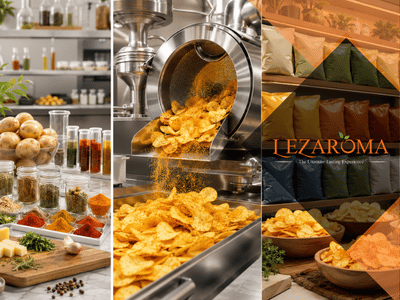
The chip powder plays a crucial role in transferring this experience from the laboratory to the production line. The powder must be homogeneous, free-flowing, and able to spread evenly across the product surface without clumping. If the particle size varies or the ingredients within the mixture separate, the flavor may differ from one batch to another. Clumping can also cause problems within the seasoning equipment and affect dosage consistency. Therefore, flavor quality alone is not enough; the powder's physical properties must also be suitable for industrial use.
The powder's adhesion to the product surface is one of the most critical factors in successful potato flavoring. This process depends on the oil content, chip temperature, production line speed, and seasoning method. If the powder is added at the wrong time, it may not adhere properly or may lose some of its aroma. If the seasoning roller speed is too high or too low, the distribution may be uneven. Therefore, precise application is just as important as the flavor formulation itself.
Lizaroma offers solutions that take these details into account, because the goal is not simply to sell ready-made powder, but to help the manufacturer achieve the best possible result. The mix or dosage can be adjusted according to production line conditions, and the final product can be analyzed after packaging to determine the stability of aroma, taste, and distribution. This collaboration gives the manufacturer the opportunity to reduce waste, improve quality, and achieve a more stable product.
It is also important that the chips have consistent flavors across production batches. The consumer who Consumers associate seasoning with a specific flavor they expect to find in every batch. If they notice a difference in saltiness, heat, or aroma, they may perceive the product's quality as inconsistent. Therefore, seasoning blends must adhere to strict standards regarding weight, mixing, and storage. Manufacturers must also monitor factors affecting the product, such as the type of oil, frying temperature, and moisture content.
The quality of raw materials directly impacts the consistency of potato chip seasoning. If the properties of an ingredient change between batches, the final taste may vary. This is why flavor companies need a rigorous system for selecting, inspecting, and storing raw materials. Blends must also be protected from moisture, air, and heat to maintain their smoothness and aroma.
Lezaroma can develop customized flavors to suit different markets, as consumers don't share the same preferences across all countries. Some markets favor high saltiness and direct flavors, while others prefer a more subtle taste. A spicy flavor might be successful in one market but need to be toned down in another. Perceptions of acidity, smoky flavor, cheese, and herbs also vary according to food culture. Therefore, adjusting the mix to suit the market helps the manufacturer increase the product's chances of success when exporting.
Custom potato flavors contribute to building diversity within the product line. The manufacturer can produce chips from the same base ingredient and then launch several varieties by changing the mix. The assortment could include a classic flavor, a spicy version, a cheesy flavor, or a flavor inspired by an international dish. This diversity gives the brand a stronger presence on store shelves and increases its reach to different consumer segments.
Manufacturers can also use chip seasonings to launch seasonal or limited-edition products. These products can be linked to a specific season, event, or marketing campaign, creating a sense of scarcity and encouraging consumers to try them. If the flavor proves successful, it can be added to the permanent lineup. This method helps test the market at a lower cost than launching an entirely new product.
Flavor also plays a significant role in product pricing. When the aroma is appealing, the taste is rich, and the distribution is consistent, the consumer perceives the product as higher quality. This increases perceived value even before reading the ingredients or learning about the manufacturing details. A weak or inconsistent flavor can make a product appear less high-quality, even if the potatoes and packaging are of good quality. Therefore, investing in professional-grade chip seasonings reflects positively on brand image and growth potential.
The cost of flavoring shouldn't be assessed solely by price per kilogram; its efficiency within the production line must also be considered. A highly concentrated blend might be more economical if it requires a lower dosage. A well-adhering powder can reduce waste within the seasoning drum and at the bottom of the containers. Consistent flavor also minimizes quality complaints and the need for line readjustments. Thus, the true value lies in the final cost per unit of product and the impact of flavor on sales and repeat purchases.
Chip flavors also need to maintain their characteristics throughout their shelf life. The product may be excellent immediately after production, but the aroma can weaken or the taste can change over time if the flavor isn't stable. Humidity can also affect the powder's flow and the product's crispness. Oils can oxidize when exposed to air or heat, leading to the development of undesirable odors. Therefore, storage tests should be conducted to monitor the product at different stages of its shelf life.
Packaging plays a crucial role in protecting the potato seasoning and its final flavor. Packaging materials must be suitable for preventing the entry of air, moisture, and light, and the seal must be airtight. The amount of air inside the package must be carefully controlled to protect the product without affecting its appearance or integrity. This illustrates that success depends not only on the blend but also on the compatibility of the flavor with production, packaging, and storage.
Sensory testing helps refine the product. Different samples can be presented to a group of consumers, who can then be asked about the intensity of the aroma, saltiness, heat, acidity, and overall impression. The flavor can also be compared to competing products to identify strengths and weaknesses. This data provides development teams with better information than relying solely on subjective opinions within the factory.
It is important to evaluate the flavor after consuming a portion of the product, as some blends may seem good at first but become heavy later. Some flavors may be pleasant initially but lack distinct character. Therefore, the flavor must strike a balance that allows the consumer to continue enjoying it without boredom or frustration. This is one of the aspects that distinguishes professional chip flavors from random mixes.
Lezaroma can transform ideas inspired by international cuisines into flavors suitable for chips and snacks. A manufacturer might want to develop a flavor inspired by a popular dish, but the dish usually contains many ingredients that cannot be transferred directly to powder. Here, the most distinctive elements of the recipe are identified, then simplified and structured in a way that clearly suits the nature of the snack. The product thus retains the spirit of the idea without becoming overloaded or incomprehensible.
This process allows for the development of flavors that combine local character with global appeal. Herbs or spices familiar to a particular market can be used and combined with a cheesy, smoky, or spicy character, resulting in a new blend with a distinctive identity. These products help attract consumers who are looking for novelty without completely abandoning familiar flavors.
Lezaroma plays a role in supporting manufacturers throughout the product development stages, from defining the concept and choosing the overall character to testing and implementation. When collaboration begins early, flavor, seasoning, dosage, and packaging can be fine-tuned. This is far better than choosing a powder at the last minute and trying to force it into a product line it wasn't designed for.
It can also be used
#Lezaroma #ليزاروما #نكهات_الشيبس #نكهات_الشيبسي #توابل_الشيبس #بهارات_الشيبس #بودرة_الشيبس #خلطات_الشيبس #نكهات_البطاطس #توابل_البطاطس #بهارات_البطاطس #بودرة_البطاطس #نكهات_المقرمشات #توابل_المقرمشات #بهارات_المقرمشات #نكهات_السناك #توابل_السناك #بهارات_السناك #نكهات_الذرة #بودرة_النكهات #نكهات_غذائية #نكهات_صناعية #نكهات_تصنيعية #نكهات_جاهزة #نكهات_مخصصة #نكهات_ثابتة #نكهات_عالية_التركيز #نكهات_عالية_الجودة #نكهات_للمصانع #نكهات_لخطوط_الإنتاج #مصانع_الشيبس #مصانع_البطاطس #مصانع_المقرمشات #صناعة_الشيبس #صناعة_السناك #صناعة_الأغذية #FoodFlavors #ChipsFlavors #PotatoFlavors #ChipsSeasoning #PotatoSeasoning #SnackFlavors #SnackSeasoning #IndustrialFlavors #FoodSeasoning #FlavorSolutions #FlavorDevelopment #LezaromaFlavors

Popular Articles