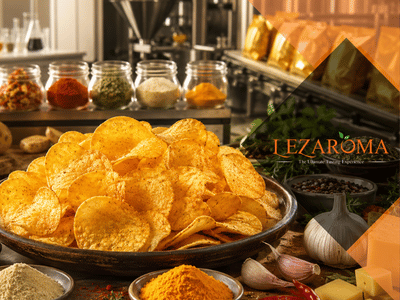
Developing new chip and potato seasoning flavors with Lezaroma to build more appealing and stable products in the market
The success of chips and crisps has become linked to the manufacturer's ability to offer a distinct and well-balanced flavor that consumers can easily remember. Markets are no longer lacking in choices; they are now saturated with dozens of brands vying for the same space in stores. In this reality, it's not enough for the packaging to be attractive or for the chips to be crispy. The brand must possess a flavor that gives the product a unique character and distinguishes it from the available alternatives. This is why chip flavors, seasonings, and spices have transformed from secondary components into essential tools in developing food products and building their brand identity.
The process of developing a successful flavor begins even before the product enters the production line. First, the target consumer and the nature of the market in which the product will be launched must be identified. Tastes vary between countries and can even differ between two cities within the same market. Some consumers prefer straightforward flavors with a distinct saltiness, while others are drawn to complex flavors that combine acidity, heat, and a smoky note. Some markets favor intense, cheesy flavors, while others prefer herbs, oriental spices, or blends inspired by local cuisine. Therefore, choosing seasonings for chips should be based on market analysis, not simply replicating a recipe that worked elsewhere.
Lezaroma treats flavor as an integral part of a product's identity. This allows them to develop blends tailored to the brand's nature and target audience. A product intended for children requires a different flavor than a snack aimed at teenagers, and a budget-friendly product demands a different technical and commercial approach than a premium product. Lezaroma understands that manufacturers aren't just looking for a flavor powder; they need a consistent, reliable, and repeatable flavor across production batches.
One of the most important factors determining the performance of chip flavors is the product's shape. Thin chips have a large surface area and are easily affected by the powder, while thicker chips require a different distribution to ensure the flavor permeates the entire chip. Corn-based snacks, on the other hand, have a different structure and a different capacity to absorb oil and spices. Therefore, flavoring cannot be used in the same way on all products, even if the flavoring has the same brand name. The success of potato flavorings depends on a balance between the powder's composition, the surface texture, the fat content, and the product's temperature during seasoning.
The oil content plays a crucial role in fixing the chip seasoning to the product. If the oil content is too low, the powder may not adhere properly, while if it's too high, the flavor may become heavy or unevenly clumped. The timing of adding the seasoning also affects the final result. A hot product may release aromas quickly, while the flavor may not distribute well if added after the product has cooled significantly. Therefore, manufacturers need to test the seasoning under real-world production conditions to determine the optimal dosage, timing, and application method.
Chip seasonings differ from homemade seasonings in their nature and function. The manufactured product must maintain the same flavor throughout extended periods of storage, transportation, and distribution. The aroma must also remain acceptable after the package is opened, and the ingredients must withstand temperature and humidity fluctuations within expected limits. Therefore, industrial blends are meticulously formulated to ensure the homogeneity of the ingredients and prevent separation during use or storage.
The flowability of the chip powder affects the efficiency of the production line, as clumped powder can cause dosage inconsistencies or blockages within the seasoning systems. Furthermore, variations in particle size can lead to heavier ingredients settling at the bottom while lighter ones remain on top. When this occurs, some packets may have a strong flavor while others have a weak one. Therefore, flavor powders must be physically homogeneous, not just taste-balanced.
Lezaroma prioritizes developing flavors that can perform efficiently within production lines, taking into account factors such as mixing speed, product temperature, humidity, and packaging method. This is crucial because a flavor that appears successful on a hand taste may behave differently when used on a large scale. Therefore, collaboration between the flavor development team and the factory helps minimize variations and achieve more consistent performance.
Successful chip flavors don't have to be overpowering, but rather clear and well-balanced. Some manufacturers increase the spice dosage to quickly enhance the flavor, but this can be overwhelming for the consumer. A very strong flavor might be appealing at first, but it loses its appeal as you continue eating. A balanced flavor, on the other hand, encourages the consumer to enjoy the product more comfortably because it doesn't rely on a single dominant ingredient, but rather offers harmonious layers of taste.
The balance lies in the interplay between saltiness, acidity, sweetness, heat, and aroma. A peppery or lemon flavor needs a distinct acidity without becoming overpowering, while a cheese flavor requires a creamy texture and just the right amount of saltiness without becoming heavy. Barbecue flavors need to combine smoky, sweet, and spicy notes in a way that creates a harmonious whole. This is where the importance of developing potato chip seasoning blends by experts who understand how each ingredient interacts with the others becomes clear.
Specific potato seasonings help create a real differentiator between brands. Dozens of products with the same flavor name may be available on the market, but consumers can distinguish between them by the subtle details. One brand's cheese flavor might be sharp and salty, while another's is smooth and creamy. The pepper's flavor may be intensely hot or develop a gradual heat level. These variations create the product's sensory character.
Lezaroma can develop customized flavors, giving the manufacturer greater flexibility in defining these details. Temperature, acidity, saltiness, aroma, and overall texture can all be adjusted according to project requirements. Several prototypes of the same mix can also be developed and compared to the actual product before final approval. This way, the flavor selection decision is based on practical testing, not guesswork.
Potato flavors play a role in supporting new product launches, as manufacturers can use a single production base and release multiple varieties by varying the seasonings. A classic flavor can be produced to target a broad audience, a spicy flavor aimed at younger consumers, a limited-edition flavor inspired by international cuisine, or a seasonal flavor linked to a marketing campaign. This diversity allows manufacturers to test the market without significant investment in new product lines.
Flavors also contribute to enhancing the perceived value of the product. When the aroma is appealing, the taste is balanced, and the distribution is consistent, consumers perceive the product as higher quality, even before knowing the specific ingredients. Conversely, if the powder is clumpy, the flavor is uneven, or the taste is inconsistent, the entire brand image can be negatively impacted. Therefore, the quality of the seasonings affects the consumer's evaluation of the product, not just its taste.
Factories also need to consider the relationship between the flavor name and the taste experience. If the packaging carries a name suggesting a strong smoky flavor, the consumer should clearly perceive this characteristic. If the product is marketed as spicy, the heat level should be appropriate for the target audience. A mismatch between the name and the taste can lead to disappointment and reduce the likelihood of repeat purchases. Therefore, potato chip flavor development should be coordinated with marketing and packaging design to ensure the visual message accurately reflects the actual experience.
An important aspect of successful chip seasoning is its ability to maintain its properties throughout its shelf life. The flavor may be excellent immediately after production, but it deteriorates over time if it is not stable or if it is affected by humidity and oxidation. Therefore, the product should be tested after different periods, paying attention to changes in aroma, taste, color, and consistency. Packaging must also be able to protect the chips from air, light, and moisture, as packaging is essential for preserving flavor.
Lizaroma is dedicated to providing flavor solutions suitable for industrial use and supporting factories in achieving consistent flavor. This includes chip flavorings, chip seasonings, potato seasonings, crisp mixes, and snack powders. These solutions can be adapted to fried, baked, or potato, corn, or other grain-based products, depending on the specific characteristics of each product.
The cost of flavoring influences the manufacturer's decision, but its evaluation should not be based solely on the price per kilogram. A highly concentrated flavoring may be more efficient if it requires a lower dosage, and a powder with good adhesion reduces in-line waste. A stable mix can save time and costs associated with readjustments or batch variations. Therefore, the final cost per kilogram of product, as well as the impact of flavoring on quality, sales, and repeat purchases, should be considered.
Professional flavoring also helps reduce reliance on arbitrary increases in salt or spices. When the formula is carefully considered, a full and distinct taste can be achieved through a balance of ingredients rather than relying on a single component. This results in a more sophisticated product experience and helps the manufacturer maintain a consistent brand image.
Global flavors have become an important part of the snack market, as consumers seek new experiences inspired by different dishes and cultures. Flavors can be developed that combine pepper and citrus, cheese and herbs, cream and onions, smoke and sweetness, or oriental spices and a spicy character. However, the success of these combinations depends on simplifying the concept and transforming it into a clear experience, because an abundance of ingredients without balance can make the taste incomprehensible.
Lezaroma can help manufacturers turn a flavor concept into a viable product. The idea might begin with a popular dish, a local recipe, or a new consumer trend. Then, the key elements that give it its character are analyzed, and a blend is created that is suitable for chips or crisps. This process requires multiple adjustments to achieve a result that preserves the spirit of the concept while remaining suitable for the industrial product.
Custom chip flavors support expansion plans into new markets because the blend can be modified according to local audience preferences. The flavor might need to be less intense in one market, more acidic in another, or have its saltiness or aroma adjusted. This flexibility allows the manufacturer to offer a product closer to consumer expectations, rather than releasing the same version in every country.
Sensory testing plays a crucial role in the development process. It's not enough for the manufacturer's team to like the taste; it must be tested on people representing the target audience. Multiple samples can be compared, and consumer preferences measured in terms of aroma, flavor intensity, heat, saltiness, and overall impression. This data helps select the most acceptable flavor and minimizes the risk of launching a product that doesn't align with the market.
The tasting experience should be monitored from the first bite to the last. Some flavors seem good initially but become overpowering later, while others take a long time to develop. A successful product offers a distinct flavor from the start and maintains its appeal without unpleasant build-up. This is a key element in designing professional chip seasonings.
Building a strong brand in the snack market depends on both continuity and innovation. The manufacturer must have consistent core flavors that consumers know and trust, along with new products that keep the market engaged. Lezaroma can support this balance by developing stable classic blends and innovative solutions that help unlock new flavors.
Having a flavor-focused partner gives the manufacturer greater ability to address issues quickly. For example, the product might experience poor adhesion.
#Lezaroma #ليزاروما #نكهات_الشيبس #نكهات_الشيبسي #توابل_الشيبس #بهارات_الشيبس #بودرة_الشيبس #خلطات_الشيبس #نكهات_البطاطس #بهارات_البطاطس #توابل_البطاطس #بودرة_البطاطس #نكهات_المقرمشات #بهارات_المقرمشات #توابل_المقرمشات #نكهات_السناك #بهارات_السناك #نكهات_الذرة #بودرة_النكهات #نكهات_جاهزة #نكهات_صناعية #نكهات_تصنيعية #نكهات_غذائية #نكهات_للمصانع #نكهات_لخطوط_الإنتاج #نكهات_عالية_التركيز #نكهات_ثابتة #نكهات_مخصصة #مصانع_الشيبس #مصانع_المقرمشات #صناعة_الوجبات_الخفيفة #FoodFlavors #ChipsFlavors #PotatoSeasoning #SnackSeasoning #FoodSeasoning #IndustrialFlavors #FlavorSolutions #LezaromaFlavors

Popular Articles