How does Lezaroma develop potato chip flavors and seasonings to suit various types of snacks
When discussing chip flavors and potato seasonings, it might initially seem that a single flavor could be applied uniformly across all types of snacks. In reality, however, the industrial landscape is quite different. A flavor that works well on thin potato chips may not yield the same result on thick or ridged varieties. Furthermore, corn-based snacks require a different approach than potato-based ones, and baked products present different requirements than fried ones. Consequently, the success of a flavor depends not only on its composition but also on its compatibility with the product’s shape, texture, oil content, surface area, and manufacturing process.
Lezaroma approaches this aspect from a practical, applied perspective. We recognize that a flavor does not exist in isolation within a package; rather, it interacts with a food base that possesses its own distinct taste, texture, and properties. Therefore, developing seasonings and flavorings for chips requires a thorough understanding of the final product before a specific blend is finalized.
In the case of thin potato chips, the surface area is large relative to the weight of each piece, meaning that even a small amount of seasoning powder can deliver a robust flavor. If too much is applied, the flavor can quickly become overpowering—especially if the blend is salty or spicy. This category, therefore, requires precise, well-balanced seasonings that allow the flavor to shine without masking the inherent character of the potato.
Thick-cut potato chips, by contrast, offer a different experience. With a greater mass and a firmer texture, the seasoning requires a stronger profile to make its presence felt. A seasoning blend that appears distinct on thin-cut chips may be less perceptible on thicker-cut varieties. In such cases, Lezaroma can adjust the concentration, dosage, or the balance of aromatic components to ensure the flavor stands out without unnecessarily increasing the salt content.
Rippled (ridged) chips present a different scenario due to their surface geometry. Their grooves and ridges retain more seasoning powder than flat chips, and spices can sometimes accumulate within the deeper recesses. This can result in some bites being overly intense, while others remain relatively bland. Consequently, the seasoning used for rippled chips must be specifically formulated to account for how the surface holds the powder.
Lezaroma carefully considers particle size and adhesion properties to ensure the flavor is distributed as evenly as possible. The objective is not simply to apply the maximum amount of seasoning, but to distribute it in a way that ensures each chip has a flavor profile consistent with the next.
Kettle-cooked chips—or those with a firmer, crunchier texture—pose a different challenge. These products typically feature a more robust crunch and a pronounced potato flavor; therefore, the seasoning must be potent enough to shine through this distinct texture and base taste. Richer, deeper flavor profiles—such as smoky, cheesy, or complex spicy blends—are often well-suited for these types of chips.
Lezaroma can develop seasonings that enhance the inherent character of such products rather than masking it. The goal is not to obscure the taste of the potato, but to strike a perfect balance between the base product and the seasoning blend. Stacked or shaped chips differ from natural potato chips in that their composition is more uniform in terms of shape, thickness, and surface area. This grants manufacturers greater control over the distribution of seasoning powders; however, it also makes any dosing error more apparent, as the individual pieces are nearly identical.
For these products, seasoning levels can be precisely calibrated, as the consistent surface area ensures a repeatable sensory experience. Nevertheless, the seasoning blend must be carefully formulated to avoid leaving an unpleasant powdery residue or causing an accumulation of seasoning inside the packaging.
Lezaroma assists in developing blends tailored to this category by fine-tuning properties such as flowability, adhesion, and concentration. Furthermore, highly distinctive flavor profiles can be created, as the uniform shape of the chips helps maintain a consistent sensory identity across every piece.
When it comes to corn-based snacks, the equation changes significantly. Corn possesses a base flavor distinct from that of potatoes—a profile that can be quite pronounced in certain products. Consequently, a seasoning designed for potato chips cannot simply be applied to corn snacks without modification.
Corn-based snacks may require a bolder flavor profile or a different balance of saltiness, acidity, and aroma. Cheese, spicy, or smoky flavors can work exceptionally well, provided they complement—rather than clash with—the natural character of the corn.
Lezaroma specializes in developing flavors for corn snacks and other snack products, customized according to the specific type—whether puffed, crunchy, or shaped. Puffed snacks, for instance, possess a light structure and a large surface area, allowing them to hold a significant amount of seasoning powder. However, this same structure can cause the flavor to be released very rapidly.
Consequently, seasonings for puffed snacks require a delicate balance: they must deliver a distinct, clear taste without the surface coating becoming overpowering. Furthermore, the particle size of the seasoning must be carefully calibrated to ensure it adheres effectively to the product rather than falling off.
For firmer corn-based snacks, a more robust flavor profile may be required to achieve the right balance with the product's texture. In such cases, the seasoning blend can be adjusted to enhance its presence, rather than simply increasing the salt content.
Baked snacks, on the other hand, require a different approach, as they typically contain less oil than fried products. This affects how well the seasoning powder adheres, given that oil acts as a medium that helps spices stay fixed to the surface.
If the oil content is too low, the seasoning powder may fall off—either inside the packaging or during transport. Therefore, the flavor profile must be specifically developed for this type of product; manufacturers might also need to adjust the application method, perhaps by using a light oil mist or another suitable binding agent.
Lizaroma assists in analyzing the complex relationship between flavor, surface characteristics, and oil content. Simply increasing the amount of seasoning is not always the solution; in fact, a higher dosage can lead to greater waste if the powder cannot adhere to the product in the first place.
Baked products are playing an increasingly significant role in the snack market. Designing custom seasonings for them offers manufacturers the opportunity to introduce a diverse range of varieties without relying on traditional frying methods—for instance, by developing cheese-flavored options.Thin chips, for instance, are consumed quickly, which influences the acceptable intensity level.
A product consumed rapidly can lead to a quick buildup of flavor; therefore, one must be cautious regarding saltiness or high heat levels. Conversely, a product consumed more slowly can sustain a deeper, more complex flavor profile.
Lezaroma helps fine-tune this aspect by testing a full serving—not just a single piece—to gauge how the consumer perceives the flavor after eating an actual portion of the product.
Market testing must also account for the snack’s format. Consumers might prefer the same flavor on one type of product over another, due to the interplay between texture and taste.
This means that the success of a flavor concept does not guarantee its success across all applications; each product requires an independent evaluation.
Lezaroma assists in developing distinct samples tailored to each specific product, allowing manufacturers to compare results with greater precision.
Shelf life is another critical factor. Products with varying oil content are affected by oxidation to different degrees, which can significantly impact flavor.
While the aroma of some snacks may remain stable for an extended period, others require greater protection. Consequently, flavor stability must be tested throughout the storage duration.
Packaging plays a vital role here, as baked or fried snacks often require an effective barrier against moisture and oxygen. If the texture degrades, the entire flavor experience is altered.
While Lezaroma helps evaluate the performance of the flavor itself, manufacturers must integrate this with the selection of appropriate packaging.
This becomes even more crucial when exporting, as products face longer transit and storage times. A flavor may be excellent at the production stage, yet arrive on the market quite differently if the product has not been tested under real-world conditions.
Therefore, snack seasonings should not be viewed as static formulas independent of the product itself. A successful flavor is one designed specifically with its actual application in mind.
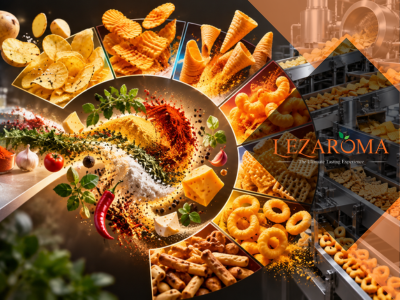
Lezaroma offers solutions for potato chips, corn-based snacks, crackers, and baked snacks. Each seasoning blend can be tailored to the product’s shape, texture, oil content, and manufacturing process.
This level of customization empowers food manufacturers to build a diverse product portfolio without compromising on quality. A brand can present a single flavor concept across various formats, while maintaining a consistent character that ties the products together.
Furthermore, this approach enhances development efficiency; manufacturers can start with a proven flavor concept and adapt it, rather than beginning from scratch every time.
Ultimately, snack seasonings cannot be separated from the product they coat. Thin, ridged, or thick-cut chips, as well as corn-based, baked, or hollow snacks, each present unique sensory and operational requirements. By understanding these nuances, Lezaroma is able to develop blends that are more precise, balanced, and compatible with production lines. This helps manufacturers deliver a clear, consistent taste across every category, transforming a single flavor concept into a diverse and scalable range of products for the market.
#Lezaroma #ليزاروما #نكهات_الشيبس #نكهات_الشيبسي #توابل_الشيبس #بهارات_الشيبس #بودرة_الشيبس #نكهات_البطاطس #توابل_البطاطس #بهارات_البطاطس #نكهات_المقرمشات #نكهات_الذرة #توابل_الذرة #بودرة_الذرة #نكهات_السناك #توابل_السناك #نكهات_السناك_المخبوز #نكهات_رقائق_البطاطس #نكهات_البطاطس_المموجة #نكهات_للمصانع #نكهات_لخطوط_الإنتاج #نكهات_مخصصة #نكهات_غذائية #نكهات_صناعية #تطوير_النكهات #مصانع_الشيبس #مصانع_المقرمشات #صناعة_السناك #صناعة_الشيبس #صناعة_الأغذية #FoodFlavors #ChipsFlavors #PotatoFlavors #CornSnackFlavors #ChipsSeasoning #PotatoSeasoning #SnackFlavors #SnackSeasoning #BakedSnackFlavors #IndustrialFlavors #CustomFlavors #FlavorApplication #FlavorDevelopment #FlavorSolutions #LezaromaFlavors

Popular Articles