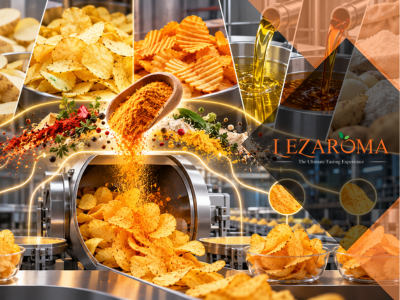
How does Lezaroma help potato chip manufacturers maintain consistent flavor, despite variations in potatoes, oils, and raw materials
In the snack and chip industry, challenges do not always stem from the flavoring itself; often, they originate with the raw materials entering the production line. Potatoes are not uniform throughout the year, oil properties can vary between suppliers, and grains—such as corn—can change depending on the season, origin, and storage conditions. While these variations may seem minor on paper, they can significantly alter a product’s taste, color, texture, and how clearly the seasonings and flavors are perceived by the consumer.
Maintaining a consistent flavor profile requires more than just using the same seasoning blend for every batch; it demands a deep understanding of the interplay between the flavoring and the base ingredient. A manufacturer might use the exact same amount of seasoning powder, yet end up with a different result due to variations in the potatoes, the oil, or the frying temperature. This highlights the importance of developing flavorings capable of performing effectively within a dynamic production environment, while ensuring the product’s core identity remains intact.
Lezaroma approaches these challenges from an integrated perspective, recognizing that snack flavorings do not function in a vacuum. The final taste is the result of a complex interaction between the potatoes, oil, heat, seasoning, and the flavor blend itself. Consequently, achieving a consistent product requires monitoring all these elements in tandem, rather than focusing solely on the seasoning powder.
The challenge often begins with the potatoes themselves. Different varieties possess varying levels of starch, moisture, and sugars—factors that directly influence the color, texture, and taste of the finished, fried product. Some potato varieties yield chips with a more pronounced, distinct flavor, while others offer a more neutral profile. In the first scenario, a flavor may need to be more balanced to harmonize with the potato’s natural taste, whereas in the second, it might emerge more prominently.
Furthermore, potatoes with higher moisture content can behave differently during frying, affecting both crispiness and oil absorption. Consequently, the intensity of the seasoning—as perceived—may shift depending on the amount of oil remaining on the surface after frying.
Lezaroma assists manufacturers in understanding these dynamics by evaluating flavors directly on the finished product. If a manufacturer notices a weaker flavor profile in a new batch of potatoes, simply increasing the dosage is not always the best solution; the issue might actually stem from thicker slices, reduced oil levels, or a change in texture.
It is crucial to analyze all these variables before making adjustments. A hasty change to the seasoning blend might address a temporary symptom, only to create a new problem once the raw materials return to their standard state.
The natural sugar content in potatoes also influences the final outcome. During frying, these sugars affect both color and taste, potentially introducing more "toasted" or roasted notes. If the base flavor of the potato becomes more pronounced, the seasoning blend may require a different balance to ensure the intended primary flavor remains distinct.
In such cases, Lezaroma can recalibrate the interplay between aromatic components, saltiness, acidity, and heat, ensuring the seasoning retains its signature character without becoming harsh or overpowering.
Chip thickness also plays a role in flavor intensity. Changes to slicing settings or the use of potatoes of different sizes can result in thicker chips. In such cases, the volume of the base material increases relative to its surface area, making the flavor appear milder—even if the dosage of the potato seasoning remains unchanged.
Conversely, thinner chips may exhibit a more intense flavor, with salt or acidity levels potentially exceeding expectations. For this reason, product thickness should be kept within strictly defined limits, and the seasoning dosage should be reviewed whenever consistent deviations occur.
Lezaroma assists manufacturers in establishing an appropriate usage range rather than relying on a single, rigid figure. A dosage spectrum can be applied based on the specific characteristics of each batch, ensuring the product’s overall flavor profile remains consistent.
This level of flexibility is crucial for large-scale production lines, as raw materials are never perfectly identical—regardless of how robust a company’s quality management systems may be. The goal is not to eliminate all variation, but to manage it in a way that remains imperceptible to the consumer.
Oil is a key factor that can alter the flavor of potato chips. Beyond its role in the frying process, it influences how seasonings adhere to the chips and how aromatic compounds are released and perceived in the mouth. Some oils are more neutral, while others possess a distinct character that can significantly impact the final flavor.
A change in the type of oil used can make a seasoning blend appear more or less pronounced. It may also alter the perceived "mouthfeel"—such as the sensation of greasiness—or change how notes like heat or smokiness are experienced. Consequently, any permanent change in the oil used must be thoroughly tested before being implemented on a large scale.
Lezaroma evaluates these types of variations by assessing the final product after the seasoning has been applied, rather than relying solely on an analysis of the flavor components themselves. In some cases, the seasoning blend does not require any modification; simply adjusting the dosage or the product temperature during the seasoning process is sufficient.
The quality of the oil during operation also affects the final result. As the oil is used for longer periods or frying conditions change, the taste of the base product itself may shift. This can introduce flavor notes unrelated to the seasoning, which nonetheless alter how the overall flavor is perceived.
Therefore, there must be coordination between the frying, quality, and seasoning teams. If the flavor seems different, it is essential to evaluate the oil before concluding that the seasoning blend itself is at fault.
Lezaroma assists in analyzing sensory differences, but the success of this solution depends on operational data from within the factory. Consequently, details such as the type of oil, temperature, duration of use, and specific production batches must be recorded, allowing any change in taste to be linked to its potential cause.
The issue is not limited to potatoes and oil. In corn-based products and other snacks, the taste of the base material can shift more significantly than expected. Corn from different origins may have a sweeter or more pronounced flavor, potentially requiring slight adjustments to the saltiness or aromatic profile of the seasonings to maintain a balanced taste.
Furthermore, products made from grains or legumes can also vary depending on the proportion of... ...moisture content and processing methods. These factors influence both the texture and the surface’s ability to retain seasoning powders.
Lezaroma helps develop more versatile seasoning blends by focusing on a clear, core flavor identity. When a blend is properly structured, it can accommodate a degree of variation in the base product without losing its fundamental character.
However, this versatility does not mean that any blend will work for any product. Clear boundaries must be established for each application, as significant differences in the base product may require a customized version of the flavor.
For instance, a manufacturer might need one version of a cheese seasoning for potato-based snacks and another for corn-based snacks, even if they share the same commercial name. The core creamy profile can be maintained while adjusting specific elements to better suit the different product bases.
This type of customization allows a brand to maintain a consistent identity across various products, without forcing the exact same blend to function in unsuitable conditions.
The moisture content of the raw material plays a crucial role in seasoning. A product with higher moisture may retain seasoning powder differently than a drier product. Furthermore, moisture can affect the product's crunch and the rate at which certain ingredients dissolve in the consumer's mouth.
If moisture levels shift, consumers may perceive the flavor as stronger or weaker, even if the seasoning formula remains unchanged. Therefore, the moisture content of the final product must be monitored according to well-defined standards.
Lezaroma helps manufacturers understand that the intensity of a flavor—such as in potato snacks—is not merely a fixed number, but the result of an entire system. The more controlled the production process, the easier it becomes to ensure consistent flavor. The degree of frying affects both color and taste, serving as one of the most significant factors that can create a noticeable difference. Darker chips typically possess a stronger, toasted character, which may render certain flavor notes less distinct, whereas lighter chips allow aromatic nuances to emerge more clearly.
If the frying temperature rises or the duration changes, consumers may perceive a difference in the product—even if the seasoning remains identical. Consequently, the color of the chips should be evaluated before any adjustments are made to the seasoning blend.
Employing visual standards alongside sensory evaluation (tasting) is highly beneficial, as color shifts can indicate changes in frying conditions or raw materials. Identifying the root cause early on minimizes the risk of making unnecessary or incorrect adjustments to the flavor profile.
While Lezaroma helps maintain a consistent flavor identity, manufacturers must establish specific parameters for color, crunch, thickness, and oil content. Collectively, these elements ensure that the seasoning blend performs as intended within the production environment.
A common challenge for manufacturers is switching suppliers—whether for potatoes, oil, corn, or other ingredients—often due to pricing or availability. While this may appear to be a purely commercial decision, it can directly impact the flavor of the chips.
Therefore, it is advisable to conduct a small-scale trial before fully committing to a new supplier. The new raw material can be tested with the existing seasoning blend, and the outcome compared against a reference sample.
If the difference is minor, no flavor adjustment may be necessary. If a significant discrepancy arises, the cause should be investigated to determine whether it is better to adjust production parameters or to develop an optimized version of the seasoning blend.
Lezaroma can support this process by comparing samples and identifying the nature and direction of any observed differences. The flavor might be less pronounced, saltier, or the heat level might manifest differently. Once identified, one can determine what kind of adjustment—if any—is required.
A reference sample is one of the most essential tools for managing variations in raw materials. A manufacturer should maintain a product that represents the desired standard for taste, aroma, color, and crunch, and then compare new batches against it.
This reduces reliance on sensory memory; otherwise, an operator or quality control officer might gradually grow accustomed to subtle shifts without noticing them. Having a clear reference, however, allows for the rapid detection of any deviation.
It is also useful to create a written sensory profile for the sample, covering aspects such as flavor intensity, saltiness, acidity, heat, aroma, and the lingering aftertaste. Such specifications help make the evaluation process more objective.
Lezaroma functions most effectively when these criteria are clearly defined, as any adjustment to potato chip seasonings can then be measured against a specific target rather than relying solely on a general impression.
Furthermore, it is crucial to document every change in raw materials. If a supplier for oil, potatoes, or corn changes, this must be reflected in the production records. Should a complaint arise from the market, one can refer back to the specific batch to determine if there was a change in the ingredients.
This data helps establish a link between cause and effect, preventing inaccurate decision-making. For instance, a manufacturer might discover that all complaints began following a change in a particular supplier, which brings the root of the problem into sharper focus.
While Lezaroma assists in flavor analysis, robust internal traceability makes the diagnostic process faster and more effective.
The evaluation process should also account for seasoning adhesion. Certain types of potato chips or snacks may have varying amounts of oil on their surface, which in turn affects the quantity of seasoning powder that adheres to the product.
If adhesion decreases, more seasoning may accumulate at the bottom of the package, leaving the consumer with the impression that the product lacks flavor. A manufacturer might attempt to compensate by increasing the dosage, but this only leads to greater waste without addressing the root cause.
In such cases, it is necessary to examine the product’s surface, the oil, the product temperature, and the seasoning process. It may be more effective to adjust the timing of the seasoning application rather than simply increasing the amount of powder used.
Lezaroma can help determine whether the seasoning blend itself requires physical property improvements or if the issue stems from operational factors.
Production line speed also plays a role. Increasing production capacity can alter the time the product spends inside the seasoning drum, which affects how the powder is distributed. This can coincide with changes in raw materials, making it even more difficult to pinpoint the exact cause.
Therefore, it is best to avoid making multiple major changes simultaneously. Altering the potatoes, oil, line speed, and seasoning all at once makes it extremely difficult to identify the source of any variation.
It is better to implement adjustments systematically and record the results of each step. This allows the manufacturer to identify exactly what caused the change in the final outcome.
Lezaroma can help.
Popular Articles