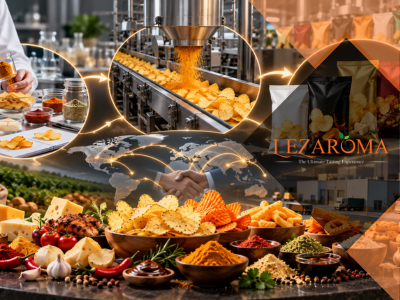
How does Lezaroma support private labels and third-party manufacturing facilities with consistent, distinctive flavors
In recent years, third-party manufacturing and private-label models have expanded significantly within the food and snack sector. It has become common for a company to own its own brand without operating a full-scale manufacturing facility; instead, a separate entity handles production and packaging according to specific requirements. In this model, chip flavors, seasonings, and spices become highly critical elements. A brand requires a unique, proprietary taste—one that must remain consistent across multiple production batches, and potentially even across different factories or production lines.
This creates challenges distinct from those found in a traditional, single-brand manufacturing plant. In a third-party production facility, several different brands might be processed on the same day, each requiring a unique flavor profile and distinct character. While the base potato product may be identical, the true differentiation between products stems from the seasonings, flavor powders, application methods, and dosage. Consequently, flavor management becomes a fundamental aspect of safeguarding each client’s brand identity.
Lezaroma navigates this environment by developing customizable blends tailored to each specific brand, ensuring that the flavor is not merely a generic mix applied uniformly across various products. Lezaroma understands that the value of a private label lies in offering a distinct sensory experience—one that remains unique to the brand, even when produced in a facility shared with other labels.
In a private-label model, a client might approach with only a preliminary concept—such as a request for a bold cheese flavor, a smoky barbecue profile, or a spicy, Middle Eastern-inspired taste—but such descriptions are often far too broad. The development process begins by transforming an idea into clear, specific requirements. What level of saltiness is desired? Should the heat profile be immediate or gradual? Should the aroma be bold or subtle? Is the product intended for children, young adults, or families? And is it positioned as an economy, mid-range, or premium product?
These factors dictate how the seasoning blend is formulated. An economy-tier product requires a distinct, potent flavor profile that is cost-effective in terms of dosage, whereas a premium product may demand greater sensory depth and complexity. Similarly, a brand targeting a younger demographic can accommodate bolder, more adventurous flavors than one aimed at families.
Lezaroma helps translate these nuances into practical samples that can be tested on the final product. This is crucial, as a brand does not merely need a flavor that is appealing in theory; it requires a flavor that performs reliably on the production line and remains stable throughout packaging and storage.
In contract manufacturing, consistency—or repeatability—is a paramount criterion. A client cannot afford for the first batch to be excellent while the second differs. If the taste varies from one production run to the next, the brand’s image will suffer, even if the manufacturer maintains high quality in other aspects.
Consequently, seasoning blends for private-label snack products must be quantifiable and controllable. The dosage, application method, oil-to-seasoning ratio, and the product’s temperature during seasoning must all be precisely defined, ensuring that success does not depend on the subjective judgment or individual experience of a specific operator.
Lezaroma develops blends with consistent physical properties—such as flowability, particle size, and homogeneity—ensuring that manufacturers can reliably replicate the desired outcome every time. The more stable a seasoning powder for chips is, the easier it becomes to maintain consistency across different production batches.
This becomes especially critical when a brand works with multiple manufacturing facilities—for instance, when production is split between different cities or countries. If each facility employs different seasoning methods or uses different equipment, the final flavor profile may end up inconsistent.
In such cases, simply providing the name of the seasoning blend is insufficient. Clear application specifications and a defined dosage range are required, along with the flexibility to perform minor calibrations based on the specific equipment used. The goal is to ensure that the consumer experiences the exact same taste, regardless of where the product was manufactured.
Lezaroma can develop a "reference blend" accompanied by application guidelines that help preserve the product’s sensory identity. While individual factories might need to make slight adjustments to dosage or the timing of the seasoning process, the final result must remain true to the approved sample.
This approach is vital for brands planning to expand. Rather than having to redevelop a flavor from scratch when switching manufacturers, a brand can maintain a core, established flavor profile and transfer it systematically to new production lines.
Furthermore, private labels must safeguard their distinctiveness. If a manufacturer produces goods for ten different clients using nearly identical seasoning blends, the market may perceive all the products as the same—which undermines a brand’s ability to establish a unique identity.
For this reason, flavors should be crafted to provide each brand with a clear, identifiable edge—whether through the specific type of heat, the character of the cheese notes, the level of acidity, the aroma, or the lingering aftertaste. Lezaroma assists in developing these variations by preparing multiple samples, allowing each client to select the option that best aligns with their vision. Existing blends can also be customized to create a more unique profile, rather than relying on a standard, off-the-shelf product.
Confidentiality is crucial in projects of this nature. A brand’s flavor is an integral part of its identity; therefore, a custom blend must be treated as a vital commercial asset.
The more distinctive a flavor is, the greater its potential to foster brand loyalty. Consumers who become accustomed to a specific taste will seek it out by name—looking for that particular signature flavor rather than just a generic category like "cheese chips" or "spicy chips." This makes flavor development a long-term investment.
In contract manufacturing, a common challenge is the frequent switching between different flavors. A production line might transition from a cheese-flavored product to a spicy one, followed by barbecue or herb-infused varieties. If these transitions are not managed correctly, traces of one flavor can carry over into the next.
While Lezaroma helps develop distinct flavor blends, the manufacturing facility must implement a rigorous cleaning protocol between production runs. Even small residues—whether from chili, cheese, or smoky seasonings—can affect the quality of the subsequent batch.
Furthermore, production schedules can be strategically organized to transition from milder flavors to more intense ones, whenever appropriate.A. This reduces certain risks and helps minimize downtime.
However, this must be done in coordination with quality and allergen requirements, as sensory-based sequencing alone is insufficient.
In the context of private labeling, quality control is even more critical, as the manufacturer is safeguarding not only their own reputation but also that of the client. Any discrepancy in taste could lead to commercial disputes between the two parties.
Therefore, a reference sample must be established for each brand. This sample serves as the benchmark for the desired flavor profile—encompassing aroma, saltiness, heat, acidity, and overall distribution.
The quality team can then compare each production batch against this reference sample to ensure the product remains within the specified parameters.
Lizaroma assists in developing a seasoning blend that can be translated into a clear, standardized specification, making it easier to track and identify any deviations.
Furthermore, a written sensory description of the product can be created—for instance, defining the heat level (from low to high) or characterizing the flavor profile (e.g., creamy, smoky, or acidic). This reduces reliance on individual subjective memory during the evaluation process.
One common challenge in contract manufacturing is the variability of raw materials between batches. For example, a manufacturer might source potatoes or oil from different suppliers, while the client continues to expect an identical flavor profile.
This highlights the importance of strict specification management. It is impossible to guarantee consistent taste if the core raw materials themselves fluctuate significantly.
While Lizaroma can adjust the seasoning blend within certain limits, it is ideal to maintain consistent specifications for the potatoes, oil, and other key ingredients.
If such variations persist, new trials can be conducted using the updated raw materials to evaluate and compare the final results. This is particularly important for brands that rely on multiple manufacturing facilities, as each facility may utilize different suppliers.
While it is possible to develop product specifications that allow for a degree of flexibility, the boundaries must be clearly defined to ensure consistency across different markets.
Lezaroma assists in this type of adaptation while preserving the core flavor profile of the brand.
Another key consideration is that a private label brand may require multiple product tiers—for instance, an economy-tier product for supermarkets and a premium-tier product for other retail channels.
In such cases, the distinction should go beyond packaging alone. Two versions of a chip flavor can be developed: an economy version that is straightforward and cost-effective, and a premium version that offers greater depth and complexity.
Lezaroma helps develop these tiers within a unified brand identity, ensuring that consumers perceive the products as belonging to the same brand.
Furthermore, flavors can be tailored to specific markets. A brand might offer a bolder flavor profile in the Gulf region, while requiring a milder version for a different market.
The product name can remain the same with minor adjustments, or a different name can be developed to better suit a specific market.
This level of customization enables private label brands to expand without sacrificing their inherent flexibility.
Such projects also demand rapid sample development, as brands are often tied to specific launch dates or seasonal sales periods.
If the flavor development process takes too long, it can delay a planned campaign. Consequently, the ability to move quickly—from concept to sample, and then to industrial-scale trial—becomes a significant advantage.
Lezaroma helps shorten this timeline, provided that key information—such as product type, price point, target market, and intended consumer segment—is clearly defined from the outset.
The more precise a client’s requirements, the faster the development process can be. Instead of relying on a single option, two or three samples can be prepared; this facilitates faster decision-making.
Once a direction is chosen, the seasoning blend is moved to a trial run on the production line.
At this stage, discrepancies may emerge between the laboratory environment and the factory floor. For instance, the intensity of the aroma might shift due to the product's temperature, adhesion may decrease based on the oil content, or the flavor profile might seem milder due to the thickness of the chips.
Lezaroma reviews these results and makes adjustments whenever necessary.
Crucially, the seasoning blend must be approved following the industrial trial—not merely before it.
In the context of private labeling, the cost of the seasoning is a fundamental component of the project. Clients often set a specific target retail or purchase price, and the seasoning blend must align with these financial parameters.
However, comparing the price per kilogram in isolation can be misleading. It is more accurate to calculate the seasoning cost per kilogram of the finished product.
A blend with a higher unit price might actually be more economical in the long run if it requires a lower dosage and results in less waste.
Lezaroma helps evaluate the seasoning from this perspective, ensuring the blend meets both taste requirements and commercial objectives.
Furthermore, the cost of product loss must be factored in. If the seasoning powder fails to adhere properly—remaining inside the processing equipment or settling at the bottom of the packaging—a portion of the investment never reaches the consumer.
Consequently, adhesion becomes a key factor in profitability.
Adhesion can be improved by fine-tuning particle size, dosage, and application methods, rather than simply increasing the quantity of seasoning used.
For contract manufacturers, such efficiencies have a broad impact, as any improvement in the seasoning process can benefit multiple product lines. Lezaroma assists in developing seasoning blends tailored to a specific production line; however, the manufacturing facility must strictly adhere to established operating procedures.
Line speed plays a critical role. If a small batch is produced at a low speed, while a larger batch is produced at a higher speed, the duration of the seasoning process may vary.
The dosage rate must be adjusted to ensure a consistent final result.
Settings can be saved for each product, simplifying the process when that product is run again.
This reduces setup time and enhances consistency.
It is also beneficial to assign a clear, unique code to each seasoning blend to prevent any confusion between products.
In facilities that handle dozens of different flavors, a simple error in selecting the seasoning powder can result in the loss of an entire batch.
Therefore, storage and organization must be clearly managed, utilizing proper labeling, batch numbering, and usage logs.
Lezaroma helps provide a specific blend for each project, making it easier for the facility to manage within its internal system.
Humidity and storage conditions also affect seasoning powders. If a package is left open or exposed to moisture, the powder may clump, which complicates accurate dosing.
Storage instructions must be integrated into the contract manufacturing system, as the client expects product consistency every time.
#Lezaroma #ليزاروما #نكهات_الشيبس #توابل_الشيبس #بهارات_الشيبس #بودرة_الشيبس #نكهات_البطاطس #توابل_البطاطس #نكهات_المقرمشات #نكهات_الذرة #نكهات_السناك #نكهات_مخصصة #علامة_تجارية_خاصة #علامات_تجارية_خاصة #إنتاج_للغير #تصنيع_للغير #مصانع_الشيبس #مصانع_البطاطس #مصانع_المقرمشات #نكهات_للمصانع #نكهات_لخطوط_الإنتاج #تطوير_المنتجات #تطوير_النكهات #صناعة_الشيبس #صناعة_السناك #صناعة_الأغذية #PrivateLabel #ContractManufacturing #PrivateLabelSnacks #FoodFlavors #ChipsFlavors #PotatoFlavors #ChipsSeasoning #PotatoSeasoning #SnackFlavors #SnackSeasoning #IndustrialFlavors #CustomFlavors #FlavorConsistency #FlavorDevelopment #FlavorSolutions #LezaromaFlavors

Popular Articles