How does Lezaroma transform potato chip flavors and seasonings into a genuine competitive advantage for brands
In the snack market, the greatest challenge is not merely producing potato chips, but creating chips that secure a lasting place in the consumer’s memory. Given that many products are similar in terms of shape, price, and size, it is the flavors, seasonings, and spices—the taste profile—that truly distinguish a fleeting market entry from a product that becomes a repeat purchase. Consequently, flavor is no longer just a final touch; it has become a core component of a brand’s commercial strategy—a factor that influences customer loyalty, sales, distribution, and even the product’s potential to penetrate new markets.
A brand may invest heavily in design and advertising, but without a distinct and memorable taste, retaining consumers is difficult. The real decision-making process begins after the first bite. If a customer finds the flavor well-balanced, unique, and memorable, a relationship with the product begins. Conversely, if the taste is generic—resembling dozens of other products on the market—then price and promotional offers become the primary drivers for purchase, forcing the brand into a grueling and perpetual competitive struggle.
This highlights the importance of developing chip flavors that grant a product a recognizable identity. Simply labeling a flavor as "cheese," "barbecue," "chili," or "lemon" is insufficient, as these options are already offered by countless companies. What makes the difference is how the seasoning blend is crafted; for instance, a cheese flavor could be creamy and mild, sharp and intense, smoky, or infused with herbs. The flavor of a pepper seasoning can be direct and spicy, gradual in its intensity, or blended with notes of acidity or smokiness. These subtle details create a sensory signature that allows a product to stand out.
Lezaroma approaches this type of development by viewing flavor as a strategic element. The company understands that a manufacturer does not merely need a powder that provides taste; rather, they require a formulation that helps build a competitive product. Consequently, factors such as the product type, manufacturing process, target market, age demographic, and sales channel are carefully analyzed, and the chip seasoning is developed in alignment with these variables.
The approach to crafting potato chip flavors differs between economy and premium brands. An economy product requires a direct, clear, and cost-effective flavor profile, whereas a premium product can offer a more complex experience through layered tastes and aromas. In both cases, however, the product must be balanced and consistent, as consumers expect a level of quality that corresponds to the price point at which they are purchasing.
A key aspect of distinctiveness is the ease with which a flavor can be identified. When a consumer tastes a product, they should be able to quickly discern its character. A flavor that lacks a clear direction—even if technically well-executed—becomes difficult to remember. Therefore, the primary element of the blend is defined first, followed by the selection of secondary components that support the main profile without competing with it.
In a barbecue flavor, for instance, smokiness might serve as the core characteristic, while notes of sweetness, tomato, and spices function as supporting elements in the background. In a cheese flavor, a creamy sensation might be the dominant element, complemented by notes of saltiness, heat, or subtle herbs. In a chili-lime flavor, the interplay between heat and acidity must be distinct, ensuring the consumer perceives a well-rounded, cohesive flavor profile.
This clarity is instrumental in building a brand. Over time, a specific taste can become synonymous with a product’s name, prompting consumers to seek it out intentionally. In this way, a flavor evolves from a mere recipe ingredient into a valuable commercial asset—a unique differentiator that competitors cannot easily replicate.
Lezaroma helps brands cultivate this distinctiveness by developing multiple variations of a single flavor. For instance, they might create versions that are spicier, creamier, or more acidic, which are then applied to the actual product for direct comparison. This approach allows a manufacturer to select a blend that truly reflects their brand identity, rather than settling for a generic formula used by many competitors.
Furthermore, snack seasonings must be tailored to the nature of the base product. Thin potato chips interact with seasonings differently than thick-cut or ridged chips, while products made from corn or other grains require entirely different formulations. Consequently, a flavor cannot be judged by the seasoning powder alone; it must be evaluated after it has been applied to the product.
The oil content also plays a critical role, as it helps carry and anchor the flavor. However, an excess of oil can result in an unpleasant, greasy mouthfeel, while too little may cause the seasoning powder to fall off. Therefore, seasonings for potato chips must function as an integral part of the product’s overall system, rather than as an isolated element.
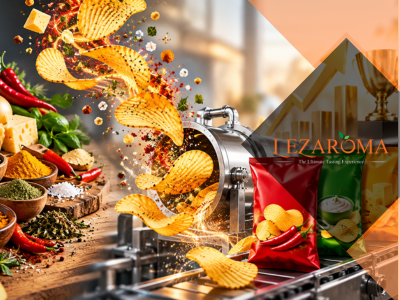
Lezaroma takes into account the complex interplay between oil, temperature, product shape, and the characteristics of the seasoning powder, with the ultimate goal of achieving a uniform distribution of flavor. If some chips are heavily seasoned while others are barely seasoned, consumers will struggle to form a consistent perception of the product. Furthermore, uneven distribution leads to higher waste and makes cost control more difficult.
This highlights the importance of adhesion. A high-quality seasoning powder must adhere effectively to the surface of the chips and be distributed consistently across all pieces. This depends not only on the powder itself but also on particle size, the speed of the seasoning equipment, the oil content, and the temperature of the chips at the time of application.
These factors also influence the product’s visual appeal. When seasoning is distributed evenly, the chips appear to be of higher quality. Conversely, a thick, uneven coating on some pieces—while others remain bare—creates an impression of poor quality or lack of care. In this sense, potato chip seasonings impact both appearance and taste.
Flavor can also help a brand target multiple market segments. For instance, a mild flavor might be developed for families, a spicy option for younger consumers, a creamy variety for children, or a bold, globally-inspired flavor for those seeking a novel experience. In this way, seasonings become a strategic tool for market segmentation and expanding the customer base.
Lezaroma helps build this diversity without... A brand risks losing its identity if it lacks consistency. While flavors may vary, they should all share a common standard—whether in terms of overall quality, balance, saltiness, or the final sensory experience. This ensures that, despite having distinct flavor profiles, the products still feel like part of the same family.
Packaging size is another crucial factor. A small, single-serve pack may require a flavor that is bold and hits the palate immediately, as it is consumed over a short period. In contrast, a family-sized pack calls for a more approachable, "easy-eating" flavor—one that can be enjoyed over a longer duration without becoming overwhelming or overly salty. Consequently, the seasoning dosage or composition for potato chips can—and should—be adjusted based on the intended consumption context.
Flavors also vary depending on the retail channel. Products sold in schools or convenience stores often require flavors that are simple and direct, whereas products aimed at niche markets or premium segments can feature more complex, sophisticated profiles. Such differentiation should be integrated into the product strategy from the very beginning.
Lizaroma has the expertise to develop potato chip flavors tailored to specific sales channels. This is particularly valuable for companies that manage multiple brands or serve diverse markets; even when manufactured in the same facility, each product requires its own unique, distinct personality.
Local culture plays a pivotal role in building a competitive advantage. A brand can achieve success by incorporating flavors inspired by dishes familiar to the local market. This approach can be far more effective than trying to compete with global corporations using standard, "classic" flavors, as a locally-inspired product resonates more deeply with the consumer.
However, translating local dishes into seasonings for potato chips requires a careful and precise simplification process. Rather than attempting to translate every component of a dish into a powder, the focus should be on selecting the most prominent elements and building the flavor profile around them. Consumers need to grasp the taste quickly; they shouldn’t have to analyze a complex recipe while enjoying a snack.
Lezaroma transforms these concepts into blends suitable for industrial production—capturing the essence of the original recipe while ensuring the flavor complements the specific nature of potato chips or other snacks. This enables manufacturers to develop products with a distinct local identity that can also be marketed internationally as novel, unique flavors.
Local character can even become an export asset. Global consumers are increasingly open to unconventional flavors, and products inspired by specific culinary traditions can pique their curiosity. However, success hinges on a clear name, design, and taste, allowing consumers to understand the experience even without prior knowledge of the original cuisine.
Flavor plays a key role in crafting a product’s marketing narrative. A spicy flavor can be framed around a sense of boldness, a smoky profile can evoke a barbecue experience, and a creamy note can suggest a rich, smooth indulgence. This narrative becomes even more compelling when the taste itself delivers on the promise made in the advertising.
If a package claims an intense flavor but the consumer finds it mild, trust is diminished. Similarly, if the design suggests a rich, cheesy experience but the actual flavor is weak, the product’s story loses its credibility. For this reason, the development of seasonings for snacks must be fully aligned with the product’s design and marketing strategy.
Lezaroma can collaborate with manufacturers from the initial conceptual stage, ensuring a cohesive connection between a product’s name and its taste. The seasoning blend may be adjusted after reviewing the packaging design, or the design itself might be modified following flavor testing. Ideally, both processes should occur in parallel to ensure a cohesive final result.
Chip flavors also influence pricing strategy. When a product offers a unique taste—one not easily found among competitors—it becomes less dependent on price-based competition. A consumer seeking a specific flavor may be more willing to pay a slight premium to obtain their preferred product.
In this sense, a distinctive flavor can enhance a brand's perceived value. When the packaging is well-executed, the taste is distinct, the seasoning is evenly distributed, and the aroma is enticing, consumers perceive the product as being of higher quality. This perception, in turn, drives sales and strengthens the brand’s ability to command a higher price point.
However, even the best flavors require consistency. If one batch is excellent while another differs, the competitive advantage is lost. Therefore, chip seasonings must deliver consistent performance, and the production line must maintain precise control over dosage, temperature, oil usage, and the seasoning application process.
Lezaroma assists in developing stable seasoning blends that can be applied consistently across production runs. Manufacturers should also maintain a reference sample to monitor new batches, comparing aroma, color, taste, and distribution to ensure the product remains true to its intended identity.
Shelf life also plays a critical role in preserving this identity; a flavor might be excellent immediately after production, only to diminish over time. The aroma may change, oils may oxidize, or the powder might absorb moisture. Any of these alterations can result in a product that reaches the consumer in a different state than the one originally approved at the factory.
Therefore, potato-based flavorings must be tested after various storage periods. Furthermore, the packaging—and its ability to protect the product from air and moisture—must be carefully evaluated. Preserving flavor is not the sole responsibility of the seasoning powder; rather, it is the result of a combined effort involving the seasoning blend, packaging, storage, and distribution.
Products intended for export require even greater attention in this regard, as transit times are longer and the product may be exposed to fluctuating temperatures. Lezaroma can develop blends specifically tailored to these conditions; however, the entire distribution chain must also be designed to maintain product quality.
Consumer complaints and feedback following a product launch play a key role in flavor development. If recurring comments arise regarding saltiness, a weak aroma, or excessive heat, these can be analyzed to refine the seasoning blend or its application. The issue may lie in the dosage rather than the formulation, or in storage conditions rather than the production process itself.
This type of analysis helps safeguard a brand’s competitive advantage, preventing arbitrary or haphazard changes to the product. A brand with a well-known, established taste must exercise caution when modifying a flavor; a significant change could alienate existing consumers, even if it happens to attract a new demographic.
Lezaroma can implement such adjustments.
#Lezaroma #ليزاروما #نكهات_الشيبس #نكهات_الشيبسي #توابل_الشيبس #بهارات_الشيبس #بودرة_الشيبس #خلطات_الشيبس #نكهات_البطاطس #توابل_البطاطس #بهارات_البطاطس #بودرة_البطاطس #نكهات_المقرمشات #توابل_المقرمشات #بهارات_المقرمشات #نكهات_السناك #توابل_السناك #نكهات_الذرة #بودرة_النكهات #نكهات_غذائية #نكهات_صناعية #نكهات_تصنيعية #نكهات_جاهزة #نكهات_مخصصة #نكهات_مميزة #نكهات_للمصانع #نكهات_لخطوط_الإنتاج #نكهات_عالية_التركيز #نكهات_عالية_الجودة #مصانع_الشيبس #مصانع_البطاطس #مصانع_المقرمشات #صناعة_الشيبس #صناعة_السناك #صناعة_الأغذية #FoodFlavors #ChipsFlavors #PotatoFlavors #ChipsSeasoning #PotatoSeasoning #SnackFlavors #SnackSeasoning #IndustrialFlavors #CustomFlavors #FlavorBranding #FlavorInnovation #FlavorSolutions #LezaromaFlavors

Popular Articles