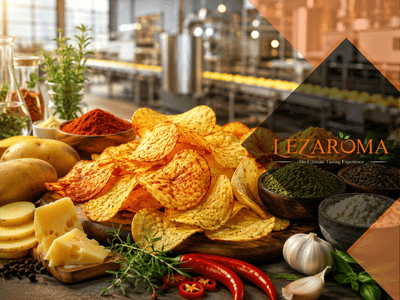
Lezaroma's chip and potato seasoning flavors and their role in developing more distinctive products in the market
Chip flavors are among the most important elements determining the success of any product in the snack sector. Consumers don't buy crisps just for their texture; they seek a complete taste experience that combines aroma, saltiness, heat, depth, and balance. Competition among chip and snack manufacturers has become fiercer than ever, so traditional mixes are no longer sufficient for widespread distribution. It has become essential to rely on professional flavors that can give the product a clear, consistent, and memorable identity. This highlights the importance of chip flavors, seasonings, and potato flavorings as an integral part of the product development process, not merely an add-on at the end of the production line.
When a consumer tastes a chip for the first time, they quickly form an impression of the product's quality. This impression begins with the aroma that emerges upon opening the package, then moves to the crunch, and finally to the intensity and balance of the flavor. If the flavor is weak, the consumer may perceive the product as ordinary, while if it is excessively strong, the experience may become unpleasant. A well-crafted flavor provides a distinct sensation from the start and maintains a balanced taste throughout. This is why food manufacturers need precise blends that harmonize the various flavor components, making the choice of flavor supplier a crucial decision for brand success.
Lezaroma develops specialized solutions for the chips and snacks sector, focusing on the needs of factories, production lines, and target markets. Lezaroma understands that each product requires different processing; thin potato chips are not the same as thick potato chips, corn chips are not the same as baked snacks, and fried products do not react to flavors in the same way as dry-heat products. Therefore, developing potato flavors is not just about the flavor name; it requires a thorough understanding of the product type, oil content, frying temperature, surface texture, powder application method, and storage time.
Chip seasonings are used to create the product's core character and can include ingredients that impart cheesy, spicy, smoky, herbal, acidic, or creamy flavors. However, a successful mix isn't about assembling the largest number of ingredients, but rather about selecting the right elements in the correct proportions. A subtle hint of acidity might be enough to bring out the flavor, while too much could mask the potato taste. Similarly, more salt doesn't necessarily mean a stronger product, as excessive saltiness can overpower other nuances. Therefore, professional chip seasonings rely on a carefully considered sensory design that ensures all elements work harmoniously together.
Chip seasonings help build the aromatic character of the product, giving it a more distinct and unique dimension. These seasonings can be inspired by local recipes, international dishes, or current trends in the snack market. Some markets prefer intensely spicy flavors, while others favor milder, smoother tastes. Some consumers prefer smoky flavors, while others seek cheesy or creamy blends. Therefore, a single blend cannot be used in the same way in every country; its concentration and balance must be adjusted to suit local tastes.
The chip powder also plays a crucial role in the quality of its application within the factory. The powder must have a suitable particle size that allows it to spread evenly across the product's surface without clumping in specific areas. It must also have good adhesion, as flavoring that settles at the bottom of the package instead of remaining on the chips' surface will not achieve the desired result. Oil directly affects this process, helping to stabilize the powder, but it can alter the taste perception if its concentration is too high. Therefore, chip flavors are developed taking into account actual application conditions, not just laboratory taste tests.
Lizaroma focuses on developing artificial flavors that can be used effectively across various production lines. A successful flavor must deliver the desired result in large-scale production, not just in small sample preparations. Differences between initial testing and industrial production may arise due to line speed, product temperature, powder addition time, and humidity levels. Therefore, the factory needs a stable and adjustable flavor, and a team capable of assisting in selecting the appropriate dosage and optimizing performance during application.
Flavor consistency is one of the most important factors affecting consumer confidence. When a customer buys a package of a particular product and becomes attached to its taste, they expect the same experience every time. If the spice intensity, saltiness, or aroma varies from batch to batch, the product may lose some of its credibility. Therefore, potato chip seasoning blends and seasonings must be manufactured according to precise standards that ensure consistency and uniformity of ingredients in every production batch.
Professional potato flavors also help differentiate a product from the competition. Many brands offer the same well-known flavors, but the real difference lies in how the taste is crafted. Several products may share a cheese name, but each offers a different experience depending on the type of cheese used in the aromatic structure, the saltiness level, the creaminess, and the final touch. The same applies to BBQ, chili, pizza, herb, cream, and onion flavors. Therefore, a brand can build its own signature by developing a custom flavor that isn't based on a generic, widely available recipe.
Custom flavors give manufacturers a greater opportunity to create a product that is difficult to imitate. When a company collaborates with Lezaroma to develop a special formula, many details can be adjusted, such as the intensity of the spices, the strength of the aroma, the acidity, the sweetness, the saltiness, and the lingering taste. These small details can be the difference between an ordinary product and one that leaves a lasting impression on the consumer. Furthermore, multiple versions of the same flavor can be developed and tested on different groups. Different before choosing the final formula.
The importance of chip flavors extends beyond the consumer market to factory efficiency and production profitability. A highly concentrated flavor can help reduce the quantity used while maintaining the desired taste, but this requires a delicate balance to avoid an overpowering or inconsistent flavor. A good mix also reduces waste due to poor adhesion or distribution and helps stabilize production standards, which is reflected in both product quality and cost.
When choosing chip seasonings, the nature of the base ingredient must be considered. Potatoes have a different taste than corn, and snacks made from grains or legumes require different flavor processing. Some base ingredients absorb flavor quickly, while others need a higher concentration to develop their taste. Texture also affects the experience, as a very crisp product may require a more pronounced flavor, while a mild product might be better suited to a smoother, more nuanced flavor.
Potato seasonings contribute to expanding the range of products a factory can offer without significant changes to the production line. The manufacturer can produce the same base and then add different blends to create several varieties. This allows for rapid market testing and the launch of seasonal, limited-edition, or targeted flavors. Products can also be developed to appeal to children, young adults, those who enjoy spicy flavors, or consumers who prefer classic tastes.
Lezaroma keeps abreast of developments in the food flavor market to offer options that align with modern consumption trends. Consumers are becoming more adventurous in experimenting with new flavors and are increasingly drawn to products inspired by international cuisines. Therefore, flavors that combine multiple elements, such as spicy and acidic, cheesy and smoky, herbs and cream, or pepper and lemon, are gaining popularity. These combinations require expertise to avoid becoming a cluttered mix and to ensure they remain clear and easily understood upon tasting.
Aroma also plays a crucial role in evaluating the flavor of chips. Before a consumer tastes the product, their brain receives the initial signal from the aroma. Therefore, the aroma must be appealing and consistent with the flavor name on the packaging. If the packaging suggests a strong flavor but the aroma is weak, the consumer may perceive a mismatch. If the aroma is overpowering and artificial, it can create a negative impression. Therefore, professional formulation aims to achieve a balanced relationship between aroma and taste.
Another important aspect is the persistence of the flavor after the package is opened. Chips can be exposed to air and moisture, and storage conditions can affect the aroma and texture. For this reason, flavor powders must be designed to maintain their performance throughout their expected shelf life. The packaging itself must also be suitable for protecting the product, because even the best flavor won't achieve the desired result if the packaging materials allow air or moisture to penetrate.
Good flavors support marketing efforts because they give the brand a story to tell the consumer. A manufacturer can launch a range inspired by specific dishes, geographical regions, spicy experiences, or creamy recipes. Each flavor has its own visual identity and marketing message. However, the success of this story ultimately depends on the authenticity of the taste experience. If the name is catchy but the taste doesn't reflect it, the product won't achieve the desired longevity.
The mention of Lezaroma in the context of potato chip flavors, seasonings, and spices reflects the company's specialization in providing solutions for food manufacturers seeking quality, variety, and consistency. A manufacturer doesn't just need a supplier selling ready-made powder; they need a partner who understands the product, the market, the consumer, and the production line. This understanding allows for the development of more competitive flavors that are more aligned with the brand's objectives.
The potato chip flavoring industry requires extensive knowledge of ingredient balance, as each element affects the others. Acidity can increase the perception of saltiness, fat can dilute certain flavors, heat can alter aroma intensity, and humidity can affect the powder's flow. Therefore, blend development must be scientific and systematic, with testing conducted on the actual product under conditions closely resembling real-world production.
Potato flavors can also be tailored to suit different price points. Some products target the budget market and require a cost-effective formula, while others target the premium market and seek a more complex and nuanced flavor. In both cases, balance and quality must be maintained, as consumers evaluate products based on their expectations, price, and market position.
Lezaroma helps manufacturers view flavor as a strategic element, not a secondary detail. A good flavor can increase repeat purchases, help the product spread through consumer recommendations, and enhance the brand's ability to retain customers. It also gives manufacturers more room to innovate and launch new versions without requiring a complete overhaul of the production structure.
In today's highly competitive market, it's essential for every brand to have one or more flavors directly associated with its name. This distinctive flavor can become a best-selling product and a gateway for the brand to enter new markets. Therefore, developing customized chip flavors is an investment in brand value and its long-term growth potential.
Lezaroma's solutions combine expertise in flavor development with an understanding of industrial application requirements. This includes chip flavors, chip seasonings, chip spices, potato flavors, crisp powders, and snack mixes. These solutions can be adapted to different products according to the factory's needs, helping to achieve a distinct taste, uniform distribution, and good stability during production and storage.
Ultimately, flavor remains the factor that transforms potato chips from a simple product into a complete experience. Design attracts attention, and price influences the purchase decision, but flavor is what truly matters.
#Lezaroma #ليزاروما #نكهات_الشيبس #نكهات_الشيبسي #توابل_الشيبس #بهارات_الشيبس #بودرة_الشيبس #خلطات_الشيبس #نكهات_البطاطس #بهارات_البطاطس #توابل_البطاطس #بودرة_البطاطس #نكهات_المقرمشات #بهارات_المقرمشات #توابل_المقرمشات #نكهات_السناك #بهارات_السناك #نكهات_الذرة #بودرة_النكهات #نكهات_جاهزة #نكهات_صناعية #نكهات_تصنيعية #نكهات_غذائية #نكهات_للمصانع #نكهات_لخطوط_الإنتاج #نكهات_عالية_التركيز #نكهات_ثابتة #نكهات_مخصصة #مصانع_الشيبس #مصانع_المقرمشات #صناعة_الوجبات_الخفيفة #FoodFlavors #ChipsFlavors #PotatoSeasoning #SnackSeasoning #FoodSeasoning #IndustrialFlavors #FlavorSolutions #LezaromaFlavors

Popular Articles