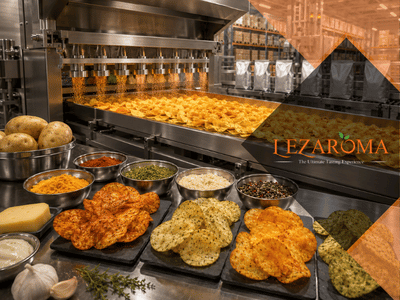
Lezaroma's chip flavors and potato seasonings represent an industrial solution for developing more stable, profitable, and scalable products
The modern potato chip industry relies on a complex interplay of factors, from raw material selection to packaging, but the element that most directly influences the consumer's perception remains flavor. Consumers don't witness the production process, nor do they know the details of frying, moisture levels, or the equipment used. However, within seconds, they can decide whether the taste is appealing and balanced or merely ordinary and unconvincing. This is why potato chip flavors, seasonings, and spices have become integral to industrial and commercial decisions, no longer simply ingredients added to the final product.
Today's potato chip manufacturers need flavors that achieve multiple objectives simultaneously. They must be appealing to the consumer, easy to apply on the production line, stable during storage, repeatable between batches, and cost-effective. If a flavor combination is successful but causes distribution or adhesion problems, it's not a complete industrial solution. Similarly, if it's easy to use but doesn't give the product a distinct character, it won't help the brand differentiate itself. Therefore, developing professional potato flavors hinges on combining sensory experience with operational efficiency.
Lezaroma addresses this equation by studying the final product, as flavor doesn't function in isolation from the other ingredients. The performance of potato seasoning can vary depending on the type of potato, chip thickness, oil content, product temperature, and seasoning method. An aroma that seems strong when evaluating the powder may become less pronounced after being added to a fatty product, and some notes may intensify after frying or storage. Therefore, Lezaroma develops blends tailored to the specific needs of the factory, not just based on a theoretical description of flavor.
The requirements of a factory producing traditional potato chips differ from those of a factory producing wavy potatoes, snack sticks, or puffed corn products. Each product has a different surface area, texture, and absorption rate. Smooth chips require rapid and even distribution, while wavy products may retain a larger quantity of seasoning powder within the grooves. Lightweight and hollow products may break if the seasoning roller's movement is not optimal. Therefore, the blend and application method must consider both the product's characteristics.
Adhesiveness plays a crucial role in the success of potato chip seasoning. When the powder doesn't adhere to the surface, waste increases, flavor intensity varies between batches, and a significant amount of seasoning settles at the bottom of the container. Consumers may interpret this as a sign of poor quality, even if the flavor itself is good. Adhesion is improved by selecting the appropriate particle size, adjusting the oil ratio, timing the powder is added, and controlling the product's temperature.
It's not enough for the potato flavoring to adhere to the product; it must also be evenly distributed. Uneven distribution results in some batches being excessively salty or spicy, while others appear almost tasteless. This inconsistency damages the brand image because it prevents consumers from having a consistent experience. Therefore, flavoring powders need physical properties that allow them to move and disperse without clumping or separating between the components.
Lezaroma prioritizes blend homogeneity because industrial powders typically contain ingredients of varying density and size. If not properly processed and mixed, the heavier components may sink to the bottom of the container or tank, while the lighter ones remain at the top. This results in taste variations throughout the product's lifespan. Good homogenization helps maintain a consistent ratio of salt, spices, and aromatic ingredients in every serving.
Determining the correct dosage is one of the most influential decisions affecting product quality and profitability. Using too little results in weak and bland chip flavors, while too much leads to a heavy taste, higher costs, and potentially powder buildup. There is no single ratio that works for all products, as dosage is affected by surface area, oil content, and blend strength. Therefore, several levels should be tested to find the optimal balance between flavor and cost.
Highly concentrated chip seasonings can be beneficial for manufacturers if used precisely, as they help achieve a pronounced flavor with less. However, high concentrations make any dosage errors more noticeable, so production lines require regular measuring systems. Moderately concentrated blends offer more flexibility but may require larger quantities. This highlights the importance of analyzing the cost of flavor per kilogram of finished product, rather than simply comparing blend prices.
Lizzaroma helps manufacturers view flavor from an overall value perspective. A particular blend might be more expensive to purchase, but it reduces waste, improves adhesion, and requires less dosage, making it more economical to apply. A better taste can also increase repeat purchases and reduce the need for marketing discounts. Therefore, evaluating potato flavors should consider their impact on operations, sales, and consumer satisfaction.
Flavor intensity depends on balance, not just saltiness. Some manufacturers might try to increase saltiness to create a stronger flavor profile, but the result is often a harsh product lacking depth. Well-crafted chip seasonings can create a fuller flavor profile by combining aroma, acidity, heat, and a creamy or smoky character, allowing consumers to clearly perceive the flavor without the saltiness dominating.
Acidity affects the perception of other ingredients. A small amount can enhance the freshness of the flavor and make the spices more noticeable. This property is used in lemon, vinegar, pepper, and sauce flavors. However, excessive acidity can make the product unpleasant when consumed in large quantities, so it should be tested as part of a complete experiment, not just a quick taste of a single chip.
As for heat, it requires a design that aligns with market demands. Not all spicy flavors are the same; some start strong from the very first moment, some develop gradually, and some...It leaves a lasting impression long after the taste is gone. The heat can be sharp and dry or warm and balanced, depending on the ingredients used. Lezaroma helps manufacturers choose a style that resonates with their target audience, rather than relying on a generic concept of spicy flavor.
Supporting notes play a crucial role in creating sophisticated chip flavors. For example, a hint of lemon, tomato, or smoke can give the flavor a more distinct identity. In a cheese flavor, creamy, herbal, or spicy elements can be used to avoid similarity to traditional products. These layers allow the brand to release a flavor familiar to the consumer, yet with a noticeable and memorable difference.
Complexity doesn't mean adding a large number of ingredients, but rather selecting those that serve a single idea. A crowded flavor can make it difficult for the consumer to identify the core taste. A clearly defined blend delivers an easily understood sensory message. Therefore, the development process begins with defining the desired character, then selecting the ingredients that support it and eliminating those that don't add real value.
Lezaroma transforms marketing ideas into viable formulations. A manufacturer might want a product that reflects a bold, youthful vibe, a comforting, family-friendly flavor, or a blend inspired by local cuisine. The concept is analyzed down to sensory elements such as heat, acidity, aroma, saltiness, and longevity, and then various samples are developed to allow for comparison and selection.
Sensory testing is a crucial step before approving potato chip seasoning. It can be conducted at the factory or with a group of the target consumers. The evaluation should not be limited to a simple question about liking the product, but should include aroma, flavor intensity, balance, longevity, and comfort after consuming a portion. Participants can also be asked how well the flavor matches the name and design on the packaging.
Tests may reveal that the strongest flavor is not necessarily the most preferred, as consumers might prefer a milder but more balanced version. A problem with the final taste might emerge even if the initial impression is positive. These results help adjust potato flavors before investing in production and distribution, reducing the risk of commercial failure.
It is also important to compare the product with competing options. This does not mean imitating them, but rather understanding the level of preference consumers are accustomed to. If the market is saturated with intense flavors, a new product may need sufficient clarity to avoid appearing weak. Conversely, a brand can differentiate itself by offering a more balanced or natural experience rather than engaging in a race to increase intensity and saltiness.
Lezaroma helps manufacturers build a clear distinction without sacrificing marketability. An overly unusual product might pique curiosity but doesn't always guarantee repeat purchases, while a familiar taste can succeed with a fresh and thoughtful twist. Therefore, a flavor can be developed starting from a known concept and then refined with elements that give it a unique identity.
Shelf life plays a crucial role in the success of powdered chips. Aromatic components can change over time or be affected by heat and humidity. Moisture absorption can lead to clumping and difficulty in use, or alter the product's appearance within the package. Therefore, mixes must be stored under appropriate conditions and in packaging that protects them from external elements.
The final product should also be tested throughout its shelf life, as the flavor isn't consumed only on the day of production. The package may reach the consumer weeks or months later and must maintain its aroma, taste, and crunch. Stability testing helps detect any changes early and allows for necessary adjustments to the mix, packaging, or storage conditions.
Oxygen affects the oils on the surface of chips, potentially leading to undesirable tastes and odors that mask the potato seasoning. Therefore, packaging materials must minimize air and moisture penetration and be airtight. Storage at high temperatures can also accelerate quality deterioration, making effective distribution chain management crucial for flavor preservation.
Lezaroma's solutions extend beyond traditional potato chips. Flavors can be developed for crackers, corn, baked snacks, and products made from grains and pulses. Each food base has a unique flavor profile and capacity to absorb seasonings, so the mix must be tailored accordingly. A corn base, for example, may require a flavor that better masks its natural taste, while potatoes may need a mix that enhances their flavor rather than completely masking it.
Manufacturers can use chip flavors as a market segmentation tool. An economy product with a straightforward taste and high application efficiency can be developed, a mid-range product with a more distinctive flavor, and a premium product with a complex formula or one inspired by international cuisine. This segmentation helps the brand reach different market segments without relying on a single product.
Flavors can also be developed to suit different package sizes. A small package might accommodate a more concentrated flavor because consumption is faster, while a large package requires a more palatable flavor that doesn't cause sensory overload after consuming a larger quantity. This detail is important when using the same mix in a multi-size range.
Potato seasonings also facilitate the launch of seasonal or experimental products. A manufacturer can test a new idea in a limited quantity, monitor sales and feedback, and then decide whether to continue with it. This approach gives the company flexibility to innovate without taking significant risk and provides direct information on market trends.
Potato flavors play a crucial role in exporting, as local tastes can vary considerably from country to country. The mix may need to be adjusted in terms of heat, saltiness, acidity, or aroma to suit each market. A customized version can be developed for each region while maintaining the brand's core identity, increasing the chances of success and preventing the launch of a product that doesn't meet consumer expectations.
Lizaroma supports this flexibility by allowing for the modification of formulas to suit specific project needs. This can include
#Lezaroma #ليزاروما #نكهات_الشيبس #نكهات_الشيبسي #توابل_الشيبس #بهارات_الشيبس #بودرة_الشيبس #خلطات_الشيبس #نكهات_البطاطس #توابل_البطاطس #بهارات_البطاطس #بودرة_البطاطس #نكهات_المقرمشات #توابل_المقرمشات #بهارات_المقرمشات #نكهات_السناك #توابل_السناك #بهارات_السناك #نكهات_الذرة #بودرة_النكهات #نكهات_غذائية #نكهات_صناعية #نكهات_تصنيعية #نكهات_جاهزة #نكهات_مخصصة #نكهات_ثابتة #نكهات_عالية_التركيز #نكهات_عالية_الجودة #نكهات_للمصانع #نكهات_لخطوط_الإنتاج #مصانع_الشيبس #مصانع_البطاطس #مصانع_المقرمشات #صناعة_الشيبس #صناعة_السناك #صناعة_الأغذية #FoodFlavors #ChipsFlavors #PotatoFlavors #ChipsSeasoning #PotatoSeasoning #SnackFlavors #SnackSeasoning #IndustrialFlavors #FoodSeasoning #CustomFlavors #FlavorSolutions #LezaromaFlavors

Popular Articles