Lezaroma’s potato chip flavors and seasonings: transforming the tasting experience into a decision to purchase again and again
In the market for chips and snacks, true success lies not in persuading a consumer to purchase a product once, but in ensuring they return time and again. While an attractive package, an advertising campaign, or a promotional price might entice a consumer to try a product for the first time, repeat purchases depend largely on the taste that lingers in their memory long after the bag is empty. Consequently, the seasonings, spices, and flavorings used in chips have become fundamental to building a long-term relationship between the product and the consumer; they do more than just provide flavor—they shape the overall impression, satisfaction, and the desire to experience the product again.
When consuming chips, a person does not analyze each element in isolation; rather, they perceive a single, cohesive experience. It begins the moment the package is opened—noticing the aroma, followed by the texture and the crunch. Then comes the evaluation of taste, saltiness, acidity, heat, and how long the flavor persists on the palate. When these elements are perfectly balanced, the product feels complete; conversely, if any single element is too intense or noticeably lacking, it can negatively affect the consumer’s assessment of the entire product.
This is where Lezaroma’s role comes into play: developing flavors that prioritize harmony among all components of the sensory experience, rather than focusing solely on intensity. Lezaroma understands that consumers do not always seek the strongest flavor; instead, they prefer flavors that are pleasant, distinct, and consistently enjoyable. There is a significant difference between a product that merely grabs attention with the first bite and one that compels a consumer to finish the entire bag—and subsequently seek it out again in the store. Successful potato chip flavors rely on a simple yet crucial principle: every component in the blend must serve a clear purpose. Saltiness enhances flavor, acidity adds vibrancy, heat provides character, and aroma stimulates the appetite, while creamy, smoky, or herbal notes contribute depth. However, if every element is equally intense, the flavor becomes overwhelming and muddled. Consequently, chip seasonings are crafted so that certain elements take center stage, while others remain in the background.
In a cheese-flavored chip, for instance, the creamy profile might be the primary note, supported—but not overshadowed—by saltiness and aroma. A subtle touch of herbs or pepper can then be added to create a unique distinction. In barbecue flavors, smokiness often takes the lead, complemented by a hint of sweetness and spices that evoke the essence of a grill. For lemon-pepper varieties, a careful balance between zest and heat is essential to ensure neither element dominates the other.
Lezaroma specializes in refining these details, tailoring them to the specific product and its target audience. A flavor designed for children, for example, may not appeal to young adults seeking bolder or spicier experiences. Products intended for families often require a "comfortable" flavor profile suitable for larger portions, whereas smaller, individual-sized packs might benefit from a more intense flavor profile. For this reason, Lezaroma considers the product within its full context, rather than viewing the flavor merely as an isolated blend.
The size of the packaging plays a more significant role in the design of potato chip flavors than many might realize. In smaller packaging, flavors can be more pronounced, as the consumer will only be consuming a limited amount. Conversely, family-sized packs require a careful balance to ensure that saltiness or spiciness does not become overwhelming as consumption continues. This highlights the importance of precise dosage; even an excellent seasoning blend can become unpleasant if used in the wrong quantity.
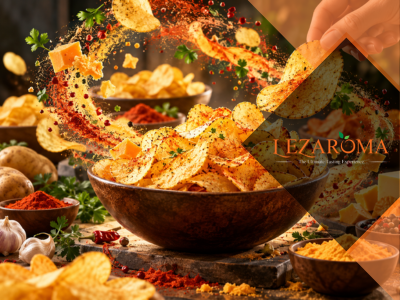
The seasoning powder plays a crucial role in achieving this balance. It must be uniform and easy to disperse, ensuring that every piece is coated consistently. If some chips are heavily seasoned while others remain nearly bare, the consumer’s experience becomes inconsistent—a chip that tastes great might be followed by one that tastes completely different, which undermines confidence in the product.
Lezaroma assists manufacturers in achieving more uniform distribution by developing seasoning powders tailored to the specific nature of each product. Thin chips, for instance, require different particle sizes and dosage levels compared to ridged or thicker chips. Furthermore, snacks made from corn, grains, or baked ingredients have different capacities for holding seasonings than traditional fried potato chips.
The oil content directly affects how well the seasoning adheres to the chips. While oil helps the powder stick, it can also influence the intensity of the flavor. If the oil content is too high, the product may feel heavy, and certain flavor notes might become overly dominant. If the oil content is too low, the seasoning may fail to adhere and instead settle at the bottom of the package. Therefore, the relationship between the oil and the seasoning must be carefully studied and tested on the actual product. One mistake that can negatively impact repeat purchases is relying on overly intense flavors designed to create an immediate, striking effect. While this approach may succeed in grabbing attention, it does not guarantee long-term appeal; a consumer might enjoy the taste at first, only to grow weary of it after a few bites. Professional flavor development, therefore, focuses on achieving what could be described as "palate comfort"—flavors that are distinct enough to be noticed, yet balanced enough to keep the consumer coming back for more.
At Lezaroma, we address this by testing flavors based on a full serving size rather than just a single piece. A true assessment cannot be made in the first few seconds; it requires experiencing an amount that reflects actual consumption. This process can reveal issues that might not be apparent initially—such as a gradual buildup of saltiness, an accumulating sense of heat, or a lingering, heavy aftertaste.
These details are crucial when developing flavors for products like potato chips intended for frequent consumption. A product consumed almost daily requires a different flavor profile than a limited-edition or seasonal item. An "everyday" flavor should be comfortable and consistent, whereas a limited-edition product can afford to be bolder or more unconventional, as its purpose is to spark curiosity and offer a novel experience.
Lezaroma can develop two types of products within the same brand: core flavors that ensure long-term consistency, and innovative flavors that drive engagement. This balance helps manufacturers build a robust product portfolio.This approach is robust: core products provide stable sales, while new releases capture attention and lend the brand an innovative image.
Furthermore, new flavors can be used to gauge shifts in consumer preferences. The market might begin to lean toward spicy, acidic, or smoky profiles, or perhaps flavors inspired by international cuisines. Rather than altering the entire product line, a brand can launch a limited-edition flavor and measure its performance. If it proves successful, it can be further developed and integrated into the permanent product range.
Lizaroma supports this type of testing by developing several distinct variations of a single concept. For instance, a spicy flavor might be crafted in varying degrees of intensity, or a cheese flavor might be developed in both creamy and bold, sharp versions. These samples are then tested on the actual product, and the version that strikes the best balance—between being distinct enough to stand out and appealing enough to encourage repeat purchases—is selected.
Sensory testing plays a pivotal role at this stage. It is not enough for the manufacturing team to simply like a flavor, as their perspective may differ from that of the general public. Groups of consumers can evaluate attributes such as aroma intensity, saltiness, spiciness, and acidity, as well as their likelihood of purchasing the product again. These results help determine whether a flavor merely sparks curiosity or possesses the genuine potential to build long-term loyalty.
Repeat purchasing does not depend on taste alone; it relies on the alignment between the actual taste and the consumer’s expectations. If the packaging promises a bold cheese flavor, the consumer should experience exactly that upon tasting. Similarly, if a product’s name implies heat, the flavor should not be mild. This consistency—between the name, the design, and the taste—strengthens consumer confidence in the product. Lezaroma helps build this alignment by focusing on the initial impact, the aroma, and the final flavor profile. If the product design suggests a rich taste, the seasoning blend can be crafted to be fuller-bodied. Conversely, if the brand aims for simplicity and a natural character, a more subtle and balanced flavor profile can be developed.
Aroma significantly influences consumer perception, as the aromatic components reach the nose the moment a package is opened. An appealing aroma can make a consumer more receptive to the taste, whereas an overly intense or artificial scent can have the opposite effect. Therefore, potato chip seasonings require an aroma that complements the product’s character without overpowering it.
Temperature on the production line plays a crucial role in preserving the aroma. If seasoning powder is applied while the product is too hot, certain aromatic components may evaporate rapidly. If applied after the product has cooled, the powder may not adhere effectively. Consequently, the timing of the seasoning process must be carefully calibrated to strike a balance between preserving the aroma and ensuring the powder adheres properly.
Lezaroma takes these details into account when developing flavors for industrial use. A blend that succeeds in the laboratory must also perform well on a high-speed production line; otherwise, it is not suitable for commercial application. Factors such as flowability, particle size, distribution, and adhesion are considered alongside the taste itself.
The flowability of the seasoning powder affects the consistency of the dosage. If the powder tends to clump, it may cause blockages within the system or result in uneven application. This leads to noticeable variations in taste from one package to another. It can also cause operational issues and increase downtime and cleaning requirements.
The seasoning blend must maintain its homogeneity during storage. If heavier components separate from lighter ones, the beginning of a package may differ from the end. Therefore, the components of a chip seasoning should have similar physical properties, or be processed in a way that minimizes separation.
Another factor influencing repeat purchases is product consistency over time. If a consumer enjoys a flavor one day but finds it different the following week, their confidence in the product diminishes. Consequently, every batch must deliver an experience consistent with previous ones—in terms of saltiness, aroma, heat, and distribution.
Lezaroma assists manufacturers in achieving this consistency by developing reproducible seasoning blends; however, the manufacturer must also carefully control their own production processes. Factors such as the type of oil used, frying temperature, production line speed, and the quantity of seasoning applied must be monitored, as any variation in these elements can alter the flavor—even if the seasoning blend itself remains unchanged.
Shelf life also impacts the consumer experience. A product that is excellent during the first week may lose some of its aroma or crunchiness after several months. If a package reaches a consumer in such a state, they will not know that the product was of high quality at the time of manufacture; instead, they will judge it based on its condition upon arrival.
For this reason, chip seasonings should be tested at various stages of storage, rather than solely immediately after production. Aroma, taste, and texture can be evaluated over time to ensure that any changes remain within an acceptable range.
Packaging plays a crucial role in preserving flavor by preventing the ingress of moisture and oxygen. If air enters the packaging, oils can oxidize, leading to unpleasant odors. If moisture gets in, the chips may lose their crunch, altering the consumer's taste experience. Consequently, the success of a potato chip’s seasoning is as much about effective packaging as it is about the seasoning blend itself.
Lizaroma helps manufacturers understand this relationship—especially when products are intended for export or long-term storage—by determining whether the flavor requires greater stability or if the packaging needs enhanced protective properties. It is also crucial to test the product under conditions that closely mirror real-world scenarios.
Consumer preferences vary by market, which directly influences repeat purchases. A spicy flavor might be a hit in one country but prove too intense in another. Some audiences may favor acidity, while others prefer cheese or smoky notes. Therefore, flavors should be tailored to specific markets whenever necessary.
Lizaroma can develop variations of the same flavor profile—maintaining a consistent core identity while adapting to the specific tastes of a local audience. This enables brands to enter new markets without compromising their unique character.
Customized potato chip seasonings also help differentiate a product from its competitors. When a flavor is generic or indistinguishable from others, price becomes the primary deciding factor. Conversely, when a product features a distinct, signature flavor, consumers have an additional reason to choose it—even at a slightly higher price point.
This link between flavor and consumer loyalty transforms seasoning into a genuine strategic investment.
#Lezaroma #ليزاروما #نكهات_الشيبس #نكهات_الشيبسي #توابل_الشيبس #بهارات_الشيبس #بودرة_الشيبس #خلطات_الشيبس #نكهات_البطاطس #توابل_البطاطس #بهارات_البطاطس #بودرة_البطاطس #نكهات_المقرمشات #توابل_المقرمشات #بهارات_المقرمشات #نكهات_السناك #توابل_السناك #بهارات_السناك #نكهات_الذرة #بودرة_النكهات #نكهات_غذائية #نكهات_صناعية #نكهات_تصنيعية #نكهات_جاهزة #نكهات_مخصصة #نكهات_للمصانع #نكهات_لخطوط_الإنتاج #نكهات_عالية_التركيز #نكهات_عالية_الجودة #مصانع_الشيبس #مصانع_البطاطس #مصانع_المقرمشات #صناعة_الشيبس #صناعة_السناك #صناعة_الأغذية #FoodFlavors #ChipsFlavors #PotatoFlavors #ChipsSeasoning #PotatoSeasoning #SnackFlavors #SnackSeasoning #IndustrialFlavors #CustomFlavors #FlavorSolutions #FlavorDevelopment #LezaromaFlavors

Popular Articles