The role of Lezaroma's chip flavors and potato seasonings in building scalable products from the local market to export
Chip and snack manufacturers no longer view flavor as a final detail added after the manufacturing process is complete. Chip flavors, seasonings, and spices have become integral to business planning from the outset. A product that succeeds in a small local market requires different characteristics when it expands to large-scale distribution or export. This is because production volumes increase, storage periods lengthen, packaging undergoes multiple stages of transport, and consumer preferences vary from region to region. Therefore, developing scalable flavors requires a vision that goes beyond immediate taste, linking the quality of the sensory experience with the stability of industrial performance and the product's ability to maintain its identity wherever it is sold.
Scalability begins with having a distinct flavor that can be easily replicated. A factory might succeed in producing a limited quantity of chips with a distinctive taste using hand-mixed blends, but the real challenge arises when production volumes increase and the line is required to produce thousands of packs daily with the same flavor. At this stage, it is not enough for the seasonings to be tasty; they must also be consistent, measurable, and precisely applied. Even a slight variation in dosage or distribution can become noticeable as production volume increases. Therefore, the mix must be designed to perform consistently under industrial conditions.
Lezaroma develops flavor solutions that meet these requirements, recognizing that a factory needs a product it can grow with. The mix used in the testing phase must be transferable to the production line without losing its balance or requiring complex modifications. This is why factors such as flavor intensity, particle size, flowability, stickiness, and aroma stability are carefully considered, in addition to its suitability for the potato type, oil, and seasoning method.
The nature of the base ingredient affects the flavor's ability to remain distinct. Potatoes vary in starch content, moisture content, and natural taste, and the frying method affects the chip's color and surface oil content. Potato flavors may be pronounced in a particular type of chip, but they may need to be adjusted when the potato supplier or manufacturing method changes. Therefore, the factory must consider the stability of raw materials alongside the stability of the chip seasoning, as any change in the nutritional base can be reflected in the final taste.
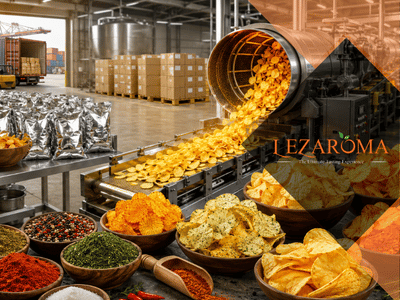
When a factory decides to increase production, it may raise the speed of the seasoning line or use larger equipment. This change affects the time the chips spend inside the mixing drum and the amount of powder delivered to each batch. If the seasoning powder is not suitable for high-speed flow, it may clump together in the dosing devices or be dispensed in irregular amounts. This can result in some packages having a strong flavor and others a weak one. Therefore, flavorings designed for production lines need properties that allow them to function stably even when speed or batch size changes.
Adhesion plays a direct role in reducing waste and increasing factory profitability. When the seasoning adheres well to the product surface, more flavor reaches the consumer instead of settling at the bottom of the seasoning drum or package. This means the factory can achieve the desired flavor with a more efficient dosage. Poor adhesion, on the other hand, increases waste, leads to flavor inconsistency, and results in a less professional product appearance.
Adhesion depends on several factors, including product temperature, oil content, and powder particle size. If the particles are too large, they may not adhere well to the chips, and if they are too fine, they may disperse in the air or clump together. The oil must also be evenly distributed, as dry areas do not retain the seasoning effectively. Industrial testing helps determine the optimal balance between these factors.
Lezaroma focuses on developing chip flavors with economic efficiency in mind. The factory doesn't measure flavor success solely by taste, but also by its impact on the final product cost. A highly concentrated blend might require a low dosage, while a less concentrated blend requires a larger quantity. The best choice cannot be determined by price per kilogram alone; the amount of flavor used per batch, waste, and performance consistency must also be considered.
Highly efficient chip seasonings help reduce frequent adjustments during production. If the blend is inconsistent, the production team has to constantly change dosages, and the line may shut down for further testing. A consistent flavor, on the other hand, simplifies adjustments and reduces downtime, increasing productivity and enabling the factory to handle larger orders.
When transitioning from the domestic market to export, shelf life becomes more critical. A product might be consumed domestically within a few weeks, but exporting can add time for transportation, customs clearance, and distribution. Therefore, potato flavorings must maintain their aroma and taste for a longer period and withstand natural temperature variations throughout the supply chain. A flavor that weakens after two months may not be suitable for a product that takes several months to reach the end consumer.
Humidity affects the quality of potato chip powder and the crispness of the final product. If the powder absorbs moisture, it may clump, and the texture of the chips may change, making them less appealing. For this reason, mixes must be stored in appropriate containers before use, and the final product must be stored in conditions that protect it from air and moisture. Packaging materials with properties suitable for the target market and the expected transport duration must also be selected.
Lizaroma offers flavor solutions that can be tailored to the requirements of different markets, because exporting does not mean sending the same local flavor to every country. Spicy flavors may be in demand in one market, while another market prefers milder flavors. Consumers in some countries may prefer pronounced acidity, while cheesy or smoky flavors are more prevalent in others. Therefore, understanding the market is key. Help modify the flavor without altering the product's core identity.
The manufacturer can retain the same flavor name and adjust its details according to the market. There might be a sharper version and a milder one, or a less salty version and another with a stronger aroma. This flexibility allows the brand to maintain a consistent product profile while offering an experience more aligned with local tastes. This is preferable to relying on a single recipe that might succeed in one place and fail in another.
Exported chip flavors also require clarity of concept. Consumers unfamiliar with the brand will rely on the flavor name and packaging image to form expectations. Therefore, the taste must be easily understood from the first bite and match the written description. If the packaging mentions pepper and lemon, the acidity and heat should be clearly and evenly distributed. If the product is smoked cheese flavored, the taste should combine fullness and a grilled quality without either element dominating.
Lezaroma helps translate marketing concepts into industrially viable blends. A manufacturer might request a flavor inspired by a popular local dish to target a specific community or offer a new experience in a different market. However, transforming a dish into potato chips isn't simply a matter of combining all its ingredients; it's about identifying the most distinctive sensory elements and crafting a blend that clearly expresses them. The flavor must remain simple enough for a light product, yet rich enough to offer a distinct character.
Local flavors can be a powerful way to differentiate oneself in export markets. Instead of competing with global brands by offering the same traditional products, a manufacturer can offer potato seasonings inspired by their own cuisine and food culture. This approach can appeal to consumers seeking new experiences, but it requires careful development to ensure the flavor is understandable even to those unfamiliar with the original dish.
The intensity of potato seasonings affects the product's appeal to repeat consumers. Some flavors are attractive in short taste tests because they are strong and surprising, but they can become tiresome after consuming an entire packet. Therefore, flavor should be evaluated based on the actual serving size, not just a single chip. A product with scalability needs a flavor that encourages repeat consumption, as sustainable sales depend on repeat purchases, not just the curiosity of the first try.
The taste experience consists of several stages, beginning with the aroma, progressing to the initial impression, the main flavor, and finally the finish. These stages must be interconnected. A barbecue flavor might start with a smoky aroma, then the blend of spices and tomatoes emerges as you chew, leaving a sweet or spicy note at the end. A cheesy flavor might begin with a distinct aroma, then offer a creamy sensation and balanced saltiness. The more structured the taste journey, the more effectively the product creates a sensory memory for the consumer.
Lizzaroma helps manufacturers develop this journey by adjusting ingredient ratios and testing multiple samples. A strong version, a mild version, and a version with a different character can be created and then compared to the actual product. Testing should be conducted after applying the powder to the chips, as the taste of the mix alone does not reflect how it interacts with the oil and potatoes.
Sensory testing is an important tool before scaling up production. The manufacturer can present samples to a group of consumers and gauge their preferences in terms of aroma, saltiness, heat, acidity, and persistence. They can also be asked if they would be willing to buy the product again, as momentary enjoyment does not necessarily indicate a purchase intention. This data helps in selecting the flavor most likely to achieve commercial success.
When exporting, testing can be replicated in the target market, as the local factory team's assessment may not reflect consumer preferences in another country. Testing may reveal that a flavor needs only minor adjustments in saltiness or heat before launch. These early adjustments are less costly than changing the product after it has entered the market.
Potato flavors also contribute to building an scalable product portfolio. A factory can launch a base flavor that achieves consistent sales and then add spicy, cheesy, smoky, or locally inspired versions. This diversity gives the brand more shelf space and reduces its reliance on a single product.
The same production line can be used to produce multiple varieties by changing the chip seasoning, but this requires careful management to prevent flavor transfer from one batch to the next. Seasoning equipment must be cleaned according to clear procedures, especially when switching between strong and different flavors. Powder storage must also be organized, and each mix must have a clear definition to minimize operational errors.
Standardized and well-defined flavors facilitate the training of production teams. When dosages and standards are clear, it becomes easier to apply them across multiple shifts or factories. This is crucial when a company expands to new lines or additional production sites. Growth requires systems that can be transferred and replicated, and flavor is a fundamental part of these systems.
Lezaroma develops flavors for factories that need consistency across different production locations. If a brand produces in more than one country or collaborates with an external manufacturer, it must maintain a consistent taste across all markets. The blend may require minor adjustments based on local raw materials, but the sensory identity must remain unchanged.
Flavor consistency protects the brand from dilution. If a product has the same name but tastes different from market to market for no apparent reason, consumers lose confidence. Considerate adjustments that take local tastes into account while preserving the core identity give the brand flexibility without compromising its identity.
Quality control plays a vital role in safeguarding the flavors of chips during expansion. A standard sample of the product should be maintained and regularly compared with production batches. The dosage can also be measured, and the powder's color, distribution, and odor can be monitored. These measures help detect any deviations before large quantities reach the market.
#Lezaroma #ليزاروما #نكهات_الشيبس #نكهات_الشيبسي #توابل_الشيبس #بهارات_الشيبس #بودرة_الشيبس #خلطات_الشيبس #نكهات_البطاطس #توابل_البطاطس #بهارات_البطاطس #بودرة_البطاطس #نكهات_المقرمشات #توابل_المقرمشات #بهارات_المقرمشات #نكهات_السناك #توابل_السناك #بهارات_السناك #نكهات_الذرة #بودرة_النكهات #نكهات_غذائية #نكهات_صناعية #نكهات_تصنيعية #نكهات_جاهزة #نكهات_مخصصة #نكهات_للتصدير #نكهات_ثابتة #نكهات_عالية_التركيز #نكهات_عالية_الجودة #نكهات_للمصانع #نكهات_لخطوط_الإنتاج #مصانع_الشيبس #مصانع_البطاطس #مصانع_المقرمشات #صناعة_الشيبس #صناعة_السناك #صناعة_الأغذية #تصدير_الشيبس #FoodFlavors #ChipsFlavors #PotatoFlavors #ChipsSeasoning #PotatoSeasoning #SnackFlavors #SnackSeasoning #IndustrialFlavors #ExportFlavors #FlavorSolutions #CustomFlavors #LezaromaFlavors

Popular Articles