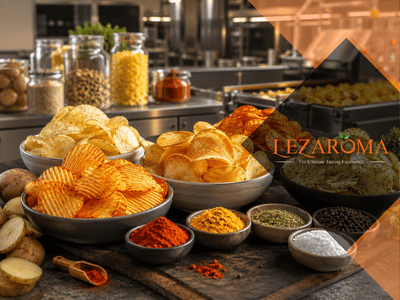
The role of Lezaroma's chip flavors and potato seasonings in improving the consumer experience and enhancing the efficiency of the food product
The chips and snack industry is experiencing a highly competitive phase. Product success is no longer solely dependent on potato quality, packaging design, or crunch; taste has become the defining factor in consumer engagement. A customer might initially be drawn to the packaging color or brand name, but they won't decide to repeat purchases until they've fully experienced the flavor. This is why chip flavors, seasonings, and spices have become crucial elements in food product development, as they are responsible for transforming simple chips into a distinct and memorable experience that consumers will want to return to.
A successful taste experience differs from simply having a strong, on-the-spot flavor. Excessive flavor can make a chip feel harsh or overpowering, while true success lies in the balance of aroma, saltiness, acidity, heat, depth, and lingering effects. When these elements are properly integrated, the consumer perceives the product as rich and distinct without being overwhelming. Therefore, developing chip flavors requires a deep understanding of how the senses perceive the product from the moment the package is opened until the last chip is finished.
The sensory experience begins with aroma, the first cue the consumer receives before tasting. If the aroma aligns with the flavor name on the packaging, a positive impression is formed, increasing the consumer's willingness to accept the product. Conversely, if the aroma is weak or differs from the description, the customer may feel the product doesn't deliver on its promises. Therefore, potato chip seasonings must be formulated to provide a clear and appropriate aroma without being overpowering or artificial.
Following the aroma comes the first taste, the moment the consumer decides whether the product is familiar, distinctive, or unbalanced. Some flavors appear quickly but disappear within seconds, while others take longer to develop. Professional flavors, however, emerge immediately but unfold gradually, starting with a clear signal that develops as you chew, leaving a final impression that encourages you to eat another chip.
Lezaroma approaches flavor development as both an engineering and sensory process. Lezaroma doesn't view the blend simply as a collection of spices; it studies how they interact with oil, potatoes, temperature, and the product's texture. Flavor can change significantly when it moves from the laboratory to the production line, so it must be tested on the final product under conditions close to actual industrial settings.
The nature of the potato affects how flavor manifests. Variations in starch content, moisture content, thickness, and degree of frying alter the taste of the chips and their ability to hold seasonings. Thin chips have a large surface area, so they require precise dosing to avoid an overpowering flavor. Thick chips may require a higher concentration or different distribution for the flavor to be clearly expressed.
Curved products require special handling because the grooves retain a larger quantity of chip powder. If distribution is not controlled, some areas may become firm while others are soft. Baked products also differ from fried products due to their lower oil content, which affects the powder's adhesion and the intensity of the flavor. Therefore, potato flavors should be developed according to the product's shape and manufacturing method.
The oil content plays a crucial role in flavor transmission. Oil helps the powder adhere, but it also affects the perception of some aromatic components. If the oil content is too low, the seasoning may fall off the surface of the chips, while if it's too high, the product may become greasy and feel heavy to the consumer. Therefore, a balance must be struck that allows the potato seasoning to adhere without affecting the texture and taste.
Lezaroma helps manufacturers determine the optimal flavor dosage based on the product type and production line characteristics. There is no single dosage suitable for all products, as surface area, oil content, and blend strength vary. A highly concentrated powder may be more economical if used efficiently, but it requires a precise dosing system to avoid noticeable differences between packages.
The cost of potato chip seasoning should be evaluated based on the actual usage, waste, and quality impact, not solely on the price per kilogram. A low-cost blend may require a large quantity or not adhere well, resulting in a higher final cost. Conversely, a more concentrated and stable blend may achieve better results with a smaller dosage, making it more efficient and profitable.
The physical properties of potato chip powder affect the performance of the production line. The powder must flow smoothly, be minimally clumped, and pass through dosing systems stably. It must also maintain its homogeneity during transport and storage, as separation of components can lead to taste variations between the beginning and end of production.
If some components of the mix are heavy while others are light, settling may occur within the container or tank. This results in inconsistent ingredient ratios in subsequent doses. Therefore, Lizaroma focuses on developing mixes that are homogeneous in terms of size, density, and distribution, ensuring a consistent ratio of salt, spices, and aromatic ingredients throughout the production process.
Adhesion is a key element in the quality of potato chip flavors. Consumers want the powder distributed evenly across the surface of the chips, not clumped at the bottom of the container. Manufacturers also aim to minimize waste and optimize mix utilization. Adhesion is affected by particle size, product temperature, oil content, and the rotation speed of the seasoning machine.
The right particles help coat the product evenly. If they are too fine, they may disperse in the air or adhere unevenly, while if they are too large, they may fall off easily. Therefore, particle size is adjusted according to the nature of the product and the application method, keeping in mind that some snack forms require a different formulation than traditional potato chips.
The quality of chip seasoning depends not only on the intensity of the flavor but also on its ability to maintain its appeal over time. The flavor may be strong and enjoyable on the first bite, but it can become less appealing over time. Unpleasant after several bites due to the accumulation of salt or heat. Therefore, mixes should be tested within a realistic portion size, not just by quickly tasting a single bite.
Larger packs require more consistent and lasting flavors because consumers tend to eat larger quantities. Smaller packs, on the other hand, can accommodate a more concentrated and faster-acting flavor. Lezaroma can adjust the strength level according to pack size and consumption pattern, ensuring each product offers a suitable experience for its target audience.
The needs of different age groups also vary. Children often prefer simple, mild flavors, while teenagers seek heat, acidity, smoky notes, and unconventional combinations. Family-friendly products require broad appeal and a balanced approach that prevents any single ingredient from dominating. Therefore, developing potato seasonings should be tailored to the target audience, not simply based on choosing a popular flavor name.
Customized chip flavors allow a brand to build its own sensory signature. While many products on the market share similar names like cheese, barbecue, pepper, and lemon, each successful brand offers a unique interpretation of these flavors. The difference might lie in the level of saltiness, the type of heat, the intensity of the smoke, or the creamy texture.
A cheese flavor can be developed with a smooth profile suitable for children, a strong and sharp version targeting younger consumers, or a smoky cheese flavor for premium customers. A sweet and smoky barbecue flavor can also be created, or a spicy one, or one rich with tomatoes and spices. This diversity allows a brand to offer products that are familiar to the consumer but different enough to be memorable.
Lezaroma builds these differences by adjusting ingredient ratios and creating multiple samples. Each sample can be tested on the final product and compared in terms of aroma, taste, heat, longevity, and compatibility with the packaging. The manufacturer then selects the version that best aligns with its vision and target market.
Sensory testing helps mitigate risks when launching new products. A blend might appeal to the manufacturer's team but not necessarily to consumers. Therefore, samples can be presented to a representative group of the target audience, and their opinions on aroma, strength, saltiness, acidity, heat, and repurchase intent can be gauged.
It's important to understand the reasons behind the preference, not just to identify the winning sample. Consumers may prefer a particular flavor because it is more balanced, even if it has a milder taste, or because its aroma is more pronounced, or because the heat is more comfortable. This information helps in developing the product scientifically rather than relying on personal taste.
Market culture influences the choice of potato flavors. Some regions prefer spicy and acidic flavors, while others favor cheese, herbs, and creamy blends. Smoking might be popular in one market and unfamiliar in another. Therefore, it cannot be assumed that the same blend will be successful in all countries.
Lizzaroma helps manufacturers adapt flavors to target markets while maintaining the product's identity. The heat can be reduced, the acidity increased, the saltiness adjusted, or the aroma intensified according to consumer preferences. This flexibility gives manufacturers a better chance when exporting or expanding into new regions.
Flavors inspired by local and international cuisines can also be developed. However, converting an entire dish into potato chips requires intelligent simplification, as a snack cannot capture all the details of the original meal. Therefore, the most distinctive elements of the dish are identified and then reconstructed into a clear blend that suits the nature of the product.
The flavor can be inspired by a popular sauce, a barbecue recipe, a spicy dish, or a blend of herbs. The goal isn't to replicate the food entirely, but to convey its essence to the chips in an easily understandable way. Lezaroma's expertise in developing these combinations helps strike a balance between authenticity and commercial appeal.
Chip flavors play a crucial role in building marketing campaigns. Spicy flavors can be presented within concepts of boldness and defiance, while creamy flavors suit messages of comfort and enjoyment. International flavors can be presented within themes of exploration and experimentation. However, the success of a campaign depends on the taste matching the promise on the packaging.
If the packaging suggests intense heat while the flavor is mild, the consumer will perceive a mismatch. If the design presents a rich cheese flavor while the taste is bland, trust in the product will diminish. Therefore, the flavor development team must collaborate with marketing and design from the outset to ensure the visual identity truly reflects the experience.
Spices also influence the surface appearance of the chips. Some blends impart an orange, red, green, or brown color, and this color must be appealing and uniform. Uneven distribution or exaggerated color can give the impression that the product is artificial or of low quality. Therefore, appearance is evaluated alongside taste and aroma.
Potato flavors need to maintain their performance throughout the shelf life. The flavor may be pronounced on the day of production but weaken over time due to heat, humidity, or oxidation. Oils may also change and develop undesirable odors that mask the flavors. Therefore, the product should be tested after different storage periods.
Packaging plays a crucial role in protecting flavor and crispness. It must prevent the ingress of air and moisture and protect the product from breakage. The seal must be airtight, and storage must be under suitable conditions. Even the best-tasting chips will not deliver a good experience if the chips lose their crispness or the oil oxidizes.
Lezaroma helps manufacturers consider the relationship between flavor and packaging, especially for products intended for export or long-term storage. The product may require packaging with enhanced protective properties or a modification to the mix to help stabilize the aroma. These elements should be tested together before large-scale commercial production.
Raw materials affect the consistency of the product's flavor. If the type of oil, potato variety, or frying method changes, the flavor may alter even if the same potato chip powder is used. Therefore, manufacturers must monitor the specifications of the raw materials.
#Lezaroma #ليزاروما #نكهات_الشيبس #نكهات_الشيبسي #توابل_الشيبس #بهارات_الشيبس #بودرة_الشيبس #خلطات_الشيبس #نكهات_البطاطس #توابل_البطاطس #بهارات_البطاطس #بودرة_البطاطس #نكهات_المقرمشات #توابل_المقرمشات #بهارات_المقرمشات #نكهات_السناك #توابل_السناك #بهارات_السناك #نكهات_الذرة #بودرة_النكهات #نكهات_غذائية #نكهات_صناعية #نكهات_تصنيعية #نكهات_جاهزة #نكهات_مخصصة #نكهات_ثابتة #نكهات_عالية_التركيز #نكهات_عالية_الجودة #نكهات_للمصانع #نكهات_لخطوط_الإنتاج #مصانع_الشيبس #مصانع_البطاطس #مصانع_المقرمشات #صناعة_الشيبس #صناعة_السناك #صناعة_الأغذية #FoodFlavors #ChipsFlavors #PotatoFlavors #ChipsSeasoning #PotatoSeasoning #SnackFlavors #SnackSeasoning #IndustrialFlavors #FoodSeasoning #FlavorExperience #FlavorSolutions #CustomFlavors #LezaromaFlavors

Popular Articles