Lezaroma's chip flavors and potato seasonings and their role in increasing production line flexibility and accelerating the introduction of new varieties
Chip and snack factories operate in a rapidly changing market, where consumers are constantly seeking new flavors, while distributors and retailers require a diverse range of products to appeal to multiple customer segments. At the same time, factories face the practical challenge of offering this variety without increasing production line complexity or raising waste and operating costs. This is where the importance of chip flavors, seasonings, and potato flavorings becomes apparent. They serve as an effective means for factories to produce multiple varieties based on a single nutritional base, with the final mix being modified in a structured and deliberate manner.
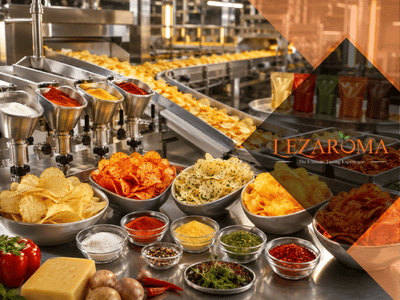
When a factory has a production line for potato chips, corn crisps, or baked snacks, it doesn't necessarily need to change the base ingredient or purchase new equipment each time it wants to introduce a different product. The same line can produce a wide variety of products simply by changing the chip powder or potato seasoning used in the seasoning stage. This makes flavoring a direct tool for increasing manufacturing flexibility, as it helps companies expand their product portfolio without fundamental changes to their production structure.
But achieving this flexibility isn't simply about purchasing a large number of spice blends. It requires planning that considers the nature of the production line, its speed, its cleaning capacity, the number of varieties required, and the expected demand for each flavor. If a large number of products are launched haphazardly, downtime between batches may increase, spice residue may accumulate in the equipment, and the likelihood of a strong flavor transferring to the next product increases. Therefore, managing chip flavors should be an integral part of daily production management, not a separate decision solely for marketing.
Lezaroma approaches artificial flavors from a product-and-product perspective. Lezaroma understands that a factory needs not only a blend that tastes good, but also a powder that is easy to use, moves smoothly through dosing systems, adheres to the product surface, and maintains consistency during operation. The more compatible the blend is with the factory equipment, the faster the transition between varieties becomes, and the less frequent manual adjustments are needed.
Production flexibility begins with having clear specifications for each flavor. The production team must know the correct dosage, the product temperature during seasoning, the required oil ratio, the mixing drum speed, and the time needed for the chips to be evenly coated with the powder. Without this information, the product's success depends on the experience of the shift worker, and the result may vary depending on team changes or line speed increases.
Practically planned mixes make seasoning a repeatable process. When the chip seasoning is consistent and uniform, the factory can define clear settings for each variety and record them in production logs. When resuming production of the same flavor after several days or weeks, the line can be run according to the previous standards and achieve results close to the approved sample, instead of starting from scratch.
The smooth flow of the chip powder is crucial. Powder that clumps or becomes stuck in the dosing machines slows down the process and may require the team to clean or dismantle parts of the system during production. Clumping also leads to inconsistencies in the amount added, resulting in some batches having a strong flavor while others have a weak one. Therefore, the mix must be designed for industrial use and maintain its flow and homogeneity under specified storage and operating conditions.
Lezaroma pays close attention to particle size and distribution because these factors affect both flowability and adhesion. If the particles are too fine, they may disperse into the air or stick to the equipment, while if they are too large, they may fall off the product surface. Proper balance helps the flavor powder transfer from the dosing system to the seasoning drum and then to the chip surface more efficiently.
Potato flavors vary in their application requirements depending on their composition. Some mixes contain strong aromatic components that require precise dosing, while others are more flexible in their application. Furthermore, some seasonings may leave a lingering odor inside the equipment after the batch has been used, which must be considered when scheduling production. Producing a highly smoky or pungent flavor before a mild, salty one can result in sensory transfer to the next batch if the line is not cleaned adequately.
The factory can mitigate this problem by scheduling the flavors from mildest to strongest. Production might begin with a simple salty flavor, then progress to herbs or cheese, and finally to smoky and spicy flavors. This sequence helps minimize the risk of milder products being affected by residues from stronger blends. However, the final decision should depend on the flavor composition, the nature of the equipment, and the cleaning procedures in place at the factory.
Lizzaroma helps factories develop blends with a clear identity without relying on ingredients that create unnecessary complexity in application. A professional flavor doesn't need a large number of elements to be distinctive; rather, it needs a balanced structure that makes the main flavor clear and the supporting elements harmonious. This approach reduces sensory overload and simplifies blend performance on the production line.
When developing a range of chip flavors for a single line, it's beneficial for blends to share some operational characteristics to facilitate smooth transitions. For example, they can be designed within similar dosage ranges or with particle sizes suitable for the same equipment. This doesn't mean the flavors have to taste identical, but rather that they are technically compatible with the seasoning system used, allowing the factory to produce a diverse range without extensive readjustments each time.
The range may include cream cheese, pepper and lemon, barbecue, herbs, and hot flavors. Each has a distinct personality, but they can all be developed to work effectively within the same line.This approach allows the factory to respond to commercial orders more quickly, especially when a distributor needs moderate quantities of several varieties rather than a large quantity of a single product.
This flexibility is particularly important for factories that work with multiple brands or produce for third parties. The production line may need to manufacture products with different flavors, concentrations, and target markets within the same week. If the seasoning for chips is unstable or requires lengthy adjustments, downtime increases, and actual production capacity decreases. Clear and easy-to-use mixes help reduce the time between production orders.
Reducing changeover time does not mean neglecting cleaning or food safety procedures. Equipment must be cleaned according to the nature of the ingredients used, and allergen residues must be removed before starting the next batch. Allergen requirements must also be considered when switching between mixes, as some potato flavors may contain ingredients that require careful management within the factory. Product information should be clear so the quality team can determine the required level of cleanliness.
Organized seasoning storage also contributes to increased flexibility. Chip flavor containers should be clearly labeled with the name, batch number, date opened, and usage instructions, and stored away from moisture, heat, and strong odors. If blends look similar, clear labeling becomes essential to avoid using the wrong flavor or adding a dosage intended for a different product.
Lezaroma provides customized flavor solutions for factories, allowing each blend to be developed to match the core product, target audience, and intended use. With clear specifications from the outset, the inventory, production, and quality teams can manage flavor more systematically, reducing errors and giving the factory greater flexibility in scheduling different varieties.
Flavors also accelerate new product development because the factory can test a market idea by modifying the spices instead of developing an entirely new production base. If there is a growing demand for spicy, smoky, or internationally inspired flavors, samples can be created on existing potato chips and tested with consumers before deciding on expansion.
This method shortens the time between idea generation and a tasting prototype. The marketing team identifies the desired trend, Lezaroma develops it into a preliminary blend, and the factory then applies it to its actual product. Based on feedback, the saltiness, acidity, heat, or aroma can be adjusted until the flavor is ready for launch.
Testing should not be limited to tasting the powder alone, as its interaction with potatoes, oil, and heat alters the result. For example, potato chip seasoning may seem strong in its dry form but becomes milder after application. Similarly, some ingredients may be more pronounced in the presence of oil, while others are diminished by the heat of the product. Therefore, sampling should be based on the final product itself.
Flexible blending allows manufacturers to produce small trial batches before committing to large commercial quantities. A limited quantity can be launched in a specific city or sales channel, and sales and consumer feedback monitored. If the flavor is successful, it is included in the permanent production schedule; if the response is limited, it can be modified or replaced without significant losses.
Lezaroma helps manufacturers create multiple versions of the same concept. A spicy flavor might be developed in three different intensities, a cheese flavor in a smooth and a strong version, or a barbecue flavor with a sweet note and a smoky version. This variety allows for genuine comparison rather than relying on the first available sample.
Sensory testing plays a crucial role in selecting a blend that combines appeal and ease of consumption. The strongest flavor isn't always the most successful, as consumers may enjoy it the first time but feel tired after consuming more. Therefore, seasonings should be evaluated based on a portion close to the actual package size, measuring the likelihood of repurchase, not just the initial impression.
Flexible production lines allow manufacturers to tailor potato flavors to each market. One country might demand a hotter version, while another requires less saltiness or more acidity. Since the base product is the same, manufacturers can adjust the blend or dosage to produce a suitable version for each customer, provided there's a clear system in place to prevent confusion.
Lizzaroma offers the ability to modify flavors while maintaining the core concept. The pepper and lemon flavor can remain familiar across all markets, but the heat and acidity levels can vary depending on the target audience. Similarly, the cheese flavor can be offered in a creamier version for one market and a sharper version for another. This gives the brand adaptability without losing its identity.
This customization requires careful management of product codes, materials, and packaging. If the packaging is similar in design, it's crucial to ensure that each flavor is linked to the correct packaging, language, and information. The production line should also be cleaned between batches if there is a significant sensory difference, ensuring that no residue remains that could affect the next batch.
Good chip flavors help reduce the need for manual adjustments during production. When the mix is consistent and the dosage is known, the operator can monitor the system instead of constantly adding random amounts in response to fleeting tastes. This increases discipline and reduces product variation between shifts.
However, when the flavor is inconsistent, the team may have to increase or decrease the dosage multiple times during a batch, leading to taste variations and difficulty in calculating costs. The start of production may differ from the end, creating complaints that are difficult to trace. Therefore, repeatability is a crucial aspect of production line flexibility.
The production speed affects the amount of seasoning that reaches the product. Increasing the speed may reduce the time available for mixing, so the powder addition rate should be reviewed.
#Lezaroma #ليزاروما #نكهات_الشيبس #نكهات_الشيبسي #توابل_الشيبس #بهارات_الشيبس #بودرة_الشيبس #خلطات_الشيبس #نكهات_البطاطس #توابل_البطاطس #بهارات_البطاطس #بودرة_البطاطس #نكهات_المقرمشات #توابل_المقرمشات #بهارات_المقرمشات #نكهات_السناك #توابل_السناك #بهارات_السناك #نكهات_الذرة #بودرة_النكهات #نكهات_غذائية #نكهات_صناعية #نكهات_تصنيعية #نكهات_جاهزة #نكهات_مخصصة #مرونة_خطوط_الإنتاج #تطوير_المنتجات #إنتاج_الشيبس #نكهات_ثابتة #نكهات_عالية_التركيز #نكهات_عالية_الجودة #نكهات_للمصانع #نكهات_لخطوط_الإنتاج #مصانع_الشيبس #مصانع_البطاطس #مصانع_المقرمشات #صناعة_الشيبس #صناعة_السناك #صناعة_الأغذية #FoodFlavors #ChipsFlavors #PotatoFlavors #ChipsSeasoning #PotatoSeasoning #SnackFlavors #SnackSeasoning #IndustrialFlavors #ProductionFlexibility #FlavorDevelopment #CustomFlavors #FlavorSolutions #LezaromaFlavors

Popular Articles